


When you’re able to overcome your health challenges and reclaim your wellbeing, it’s a win–win.
The win for you is clear: you get to feel more like yourself again. You get to live with more energy, more clarity, and more alignment with the things that matter to you – not boxed in by symptoms or dragged down by fatigue.
But there’s a second win too, and it feels a little vulnerable to say…
When you get better, we get to help more people. When your treatment is successful, it strengthens our conviction in what we do, it reinforces that our model works, and it opens our practitioners’ calendars so others can also get the support they need. I wouldn’t normally refer so boldly to our business success, but it’s true – your success fuels our mission, and we’re here because we genuinely want you to get better.
Where good treatment plans fall apart (and it’s not where you think)
Whenever a practitioner meets with someone, their intention is to uncover what’s going on beneath the surface and design the treatment strategy that can help to resolve it.
But here’s something almost everyone has experienced: You walk out of your appointment feeling like yes, I get this, and then hours – or days – later the details start slipping away.
Even with detailed treatment notes, sometimes the context fades. Sometimes the “why” behind each step blurs. And when that happens, it’s very easy for the whole plan to slide quietly into the mental “too hard for now” basket.
But even if you do remember everything? The hardest part is still ahead.
Because the real work isn’t in knowing what to do.
It’s in doing it – consistently and in the middle of a real life that has stress, family, work, fatigue, and curveballs.
This is where the gap forms… and where coaching steps in.
The behavioural science: why we struggle with change (even when we’re highly motivated)
In a decade of coaching, I’ve noticed something fascinating – and comforting: people don’t struggle because they’re lazy, unmotivated, or undisciplined. They struggle because they’re human, myself included. In fact, I hired a health coach a few years ago to support me with some habits I was trying to instil.
Behavioural science tells us that much of what we do is driven by subconscious patterns – automatic habits the brain wires over time to save energy.
We repeat what’s familiar, even when the familiar isn’t helping.
Because familiar feels:
- safe
- predictable
- effortless
And change feels:
- new
- uncertain
- energy-intensive
So even when we genuinely want to feel better, our brains default to old habits because they’re simply easier to run. It’s not a moral failing and it’s not stubbornness.
It’s biology.
Change requires building new neural pathways – and that takes time, repetition, and support. Which is exactly where coaching becomes such a powerful ally.
How coaching bridges the gap between intention and action
Sometimes when I’m explaining coaching to a new patient, I’ll sound like I’m waffling or that I’m inarticulate – because this role really is dynamic and must adapt to the greatest need of the patient in each coaching session. Instead of trying to explain the skills involved in coaching, I tend to instead focus on why we’re here. I say something like “I’m here to help you stay on track to make change so that you can get the success you’re looking for”.
If I’m putting it into one word, it is ‘implementation’. How we get there is wildly different from one person to the next because we all have unique health behaviours and beliefs and patterns and then of course very different treatment strategies.
Health coaching is the space where understanding turns into action. It’s the support that carries you from “I know what I need to do” to “I’m actually doing it – and it finally feels possible.”
At Melbourne Functional Medicine, coaching boosts:
- adherence (because things finally feel doable)
- confidence (because someone is walking alongside you)
- long-term change (because the habits you build are small, sustainable, and personalised)
It offers what a practitioner simply cannot fit into a single appointment:
- emotional support
- mindset coaching
- troubleshooting in real time
- behaviour change expertise
- day-to-day practical strategies
And when coaching is integrated with treatment plans, outcomes improve across the board: better consistency, fewer setbacks, clearer progress, and far less overwhelm.
I was just coaching a patient who was having difficulty with food in the context of weight management. He finds himself craving carbs and has a very clear health goal which involves steady weight loss.
He said something like “I could ban certain foods for about 5 or 6 months to lose the weight”. As his coach, I asked him to share what mattered most to him (his weight and fitness goals) and we realigned with his future vision.
If he decided to ‘buckle down’ and ‘push through’ using motivation and willpower to stop eating those refined foods, he might be able to do it. As his coach, my goal is to help him learn about his body, learn when he feels his best and be able to SUSTAIN his change for a healthy life (beyond 5 months).
And so we made a more durable plan, led by him. One in which he makes healthy choices most of the time and then, on those occasions where he is going to opt in to something ‘carby’, he makes choices around quality. So, if he chose a pizza, instead of a meaty, cheesy pizza, he might instead choose one that is loaded with vegetables.
Small, yet significant changes to the foundations of his food habits which will still allow for him to enjoy socialising and connecting through food. But importantly, not a short-term, mind endurance event – but rather a way of eating that will become his ‘norm’.
A look inside the MFM process (where coaching makes the biggest difference)
Most people haven’t worked with a practitioner and a coach. Here’s how it usually unfolds.
People come to us feeling urgent and determined. They’ve often been unwell for a long time, and they’re ready – really ready – to understand what’s going on.
They go through the deep dive, get clarity, and feel hopeful. Momentum builds quickly.
We start with functional testing, which is very practical – tick the box, send the sample, done. Momentum stays high here.
But once testing is complete, we step into the territory of daily habits: nutrition, sleep, movement, stress, boundaries, routines.
And this is where things can begin to feel a little more challenging.
Because in this territory, we meet your patterns. Your autopilot behaviours. Your old coping mechanisms. This is where change becomes emotional, not just instructional.
And it’s exactly the sweet spot for coaching.
A coach helps you:
- recognise patterns without judgement
- reconnect habits to your goals
- embed micro-shifts that build real momentum
- navigate the overwhelm that comes with any behaviour change
- understand why a step matters, not just what to do
“Your practitioner sets the direction. Your coach helps you take the steps – at a realistic pace – without drowning in it.”
– Bee Pennington
I often say to patients “your practitioner is the accelerator and I am the handbrake”. What I mean is, you’ll have your complete treatment plan with lots of details of what to change, what to reduce or introduce and how to go about your strategy. This can, for many, feel a bit overwhelming, and so I step in and support the patient to prioritise. We agree on the most important elements, with the aim to make all of the changes, but in a way that means you’re still doing them in 12 months.
I’ve seen it so many times – when you’re so enthusiastic and you just want to do everything at once. Chances are, we’ll be chatting in about 4 weeks because you lost pace, you felt like it was too much, and you fell off the wagon because it became unsustainable.
Change is tempered and I can say with certainty that the best change is that which is made slowly and has become ‘sticky’ before you bring in the next thing.
Why you need both: the practitioner + coach partnership
Your practitioner provides a detailed, comprehensive plan based on science, testing, and clinical insight. That becomes your roadmap.
Your coach helps you walk it.
They help you prioritise what to do first. They break complex steps into bite-sized ones. They support you when motivation drops. They remove roadblocks. They help you integrate the plan into the real flow of your life.
The intention isn’t to divide roles – it’s to create a team around you, each person doing what they’re best at.
Together, they give you clarity, structure, emotional support, and practical implementation. A complete ecosystem for healing.
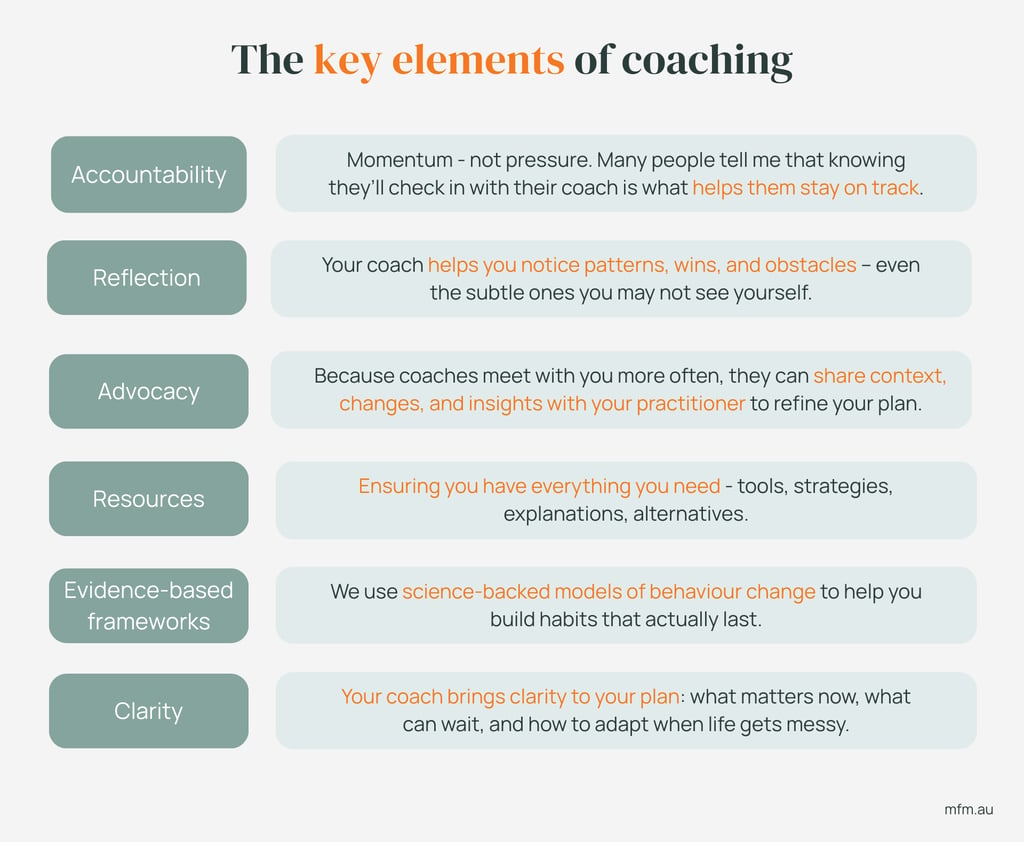
The key elements of coaching
Working with a coach adds depth and practicality to your treatment experience. Some of the core elements include:
Why coaching matters (even when you have an excellent practitioner)
Your practitioner brings depth of knowledge in physiology, biochemistry, pathology, and clinical reasoning. They’re experts at uncovering what’s driving your symptoms and mapping out the treatment strategy that will move you forward. They give you the what and the why – the essential clinical roadmap. However, designing a treatment plan and helping someone change their behaviour are two entirely different skillsets.
Practitioners are trained extensively in clinical science. Coaches are trained extensively in behaviour change.
So while your practitioner guides the clinical direction, they’re not the ones equipped to support the emotional, psychological, and practical realities of implementing change – especially the complex human patterns around motivation, habit formation, identity, and capacity.
And because practitioner appointments are focused on assessment, strategy, and treatment progression, they simply cannot provide the ongoing, high-touch support required to turn recommendations into long-term habits.
This is where coaching completes the picture.
Coaches sit with you in the how: how to build habits, how to navigate resistance, how to maintain momentum, and how to make the plan work in the messiness of real life.
They specialise in the human side of healing, which is often the part people struggle with most.
Together, practitioner and coach create a collaborative model: clinical expertise + behaviour change expertise = better outcomes, less overwhelm, and a far smoother path forward.
Coaching is for everyone
Coaching isn’t formulaic and it’s not a checklist. It’s personalised and agile.
Some days you’ll come in motivated and organised. Other days, you’ll feel tired, overwhelmed, or unsure where to start.
A good coach meets you exactly where you are. Not where you “should” be.
They notice when you’re stretching yourself in a good way, and when you’re pushing from old habits of perfectionism or pressure. They adjust your pace when your energy changes. They hold the bigger vision when you temporarily lose sight of it.
And they help you turn the clinical plan into something that fits your real life – not an imaginary ideal week that never arrives.
One of the most surprising things? People who say “I don’t need coaching” often become the ones who love it most.
The real win-win
When you reclaim your health, it’s a win for you – a return to clarity, energy, focus, and your sense of self.
And yes, it’s a win for us too, because your success fuels our mission to help more people break free from chronic symptoms and step into a life that feels fulfilling and more easeful.
But between those wins is the quiet, transformational work of change – the conversations, the reflections, the small decisions that compound over time.
Practitioners create the roadmap. Coaches help you walk it. And you bring the commitment, curiosity, and willingness to grow.
When those three elements come together, transformation stops being a hopeful idea and becomes your lived reality.
If you’re here, reading to the end, that tells me something important about you: you’re already invested and you’re likely ready for something to shift.
And in my experience, that makes you exactly the kind of person who thrives with coaching.
Get started today
Our expert health coaches are ready now to work with new and existing patients of Melbourne Functional Medicine. Get started today.