
Traditional v Infrared. You’ve landed here because you’re wondering which one to buy (or which one to use at your gym). This is a wonderful topic because the answer is not cut and dry. I’ve reviewed the science, differences, pros, cons for both, and our team even helped me produce some handy comparison tables . Buckle up, grab your water bottle (hydrated is a good place to start) and let’s go!
Why sauna in the first place?
First things first, no matter your choice, sauna use offers numerous health benefits. Saunas primarily work as a heat stress for the body. This type of controlled and deliberate stress can have hormetic benefits. And just like exercise or fasting, controlled and deliberate stressors mean the body adapts and comes back stronger and more resilient.
Heat shock proteins are released when you heat your body in a controlled way (e.g. sauna and hot baths), and these special proteins stimulate cellular repair, which means your cells become stronger and more resistant to internal stressors in the body, like oxidation. If you’d like to geek out more on these proteins, I recommend checking out Table 4 in this paper. Heat shock proteins also significantly bolster the immune system.
Sauna benefits
Now, I’m sure you’ve read all the benefits of this type of heat exposure (hence why you might like your own sauna right at home); here’s the list of top health benefits associated with regular sauna use:
- lower risk of developing Alzheimer’s disease
- reduced risk of developing cardiovascular disease (helps create healthier arteries and reduces inflammation)
- reduction in muscle loss
- living longer
- sleeping better
- reduced sickness
The type of sauna you choose may have additional benefits over the other. This breakdown clearly covers the differences and helps you make the best decision for your goals.
Traditional saunas
What is a traditional sauna?
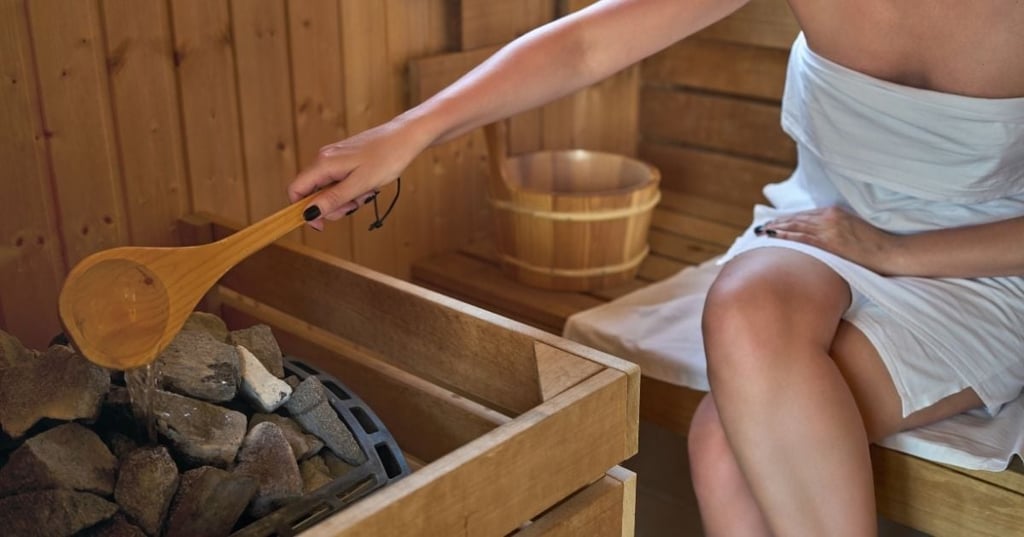
A traditional sauna is a heated wooden box that gets very hot. It heats the air around you, usually to somewhere between 70 and 100°C, using a wood-, electric- or gas-fired heater and rocks. You sweat because the room itself is hot. Sometimes you’ll throw water on the rocks for a hit of steam (the Finns call this löyly, and yes, it’s a whole vibe).
History
Sauna culture goes back thousands of years in Finland, originally dug into hillsides and heated with fire before evolving into the freestanding wooden rooms we know today. Finns gave birth in saunas, treated illness in them, and socialised in them. There are more saunas than cars in Finland, and you’ll find that even most hotel rooms have them!
Research and health benefits
This is where traditional saunas have a real head start: decades of data. The 1989 Kuopio Ischaemic Heart Disease study followed over two thousand Finnish men for two decades and found that frequent sauna use (several times a week) was correlated with meaningfully lower rates of cardiovascular death and all-cause mortality. Since then, numerous studies have built on that insight, linking regular sauna use to:
- lower blood pressure
- better vascular function
- reduced risk of conditions like dementia and respiratory illness
- triggering a post-sauna relaxation response
- improving sleep
How to use a traditional sauna
If you’re chasing the longevity angle, here’s the protocol I’d point you to:
Session time: around 15 to 30 minutes
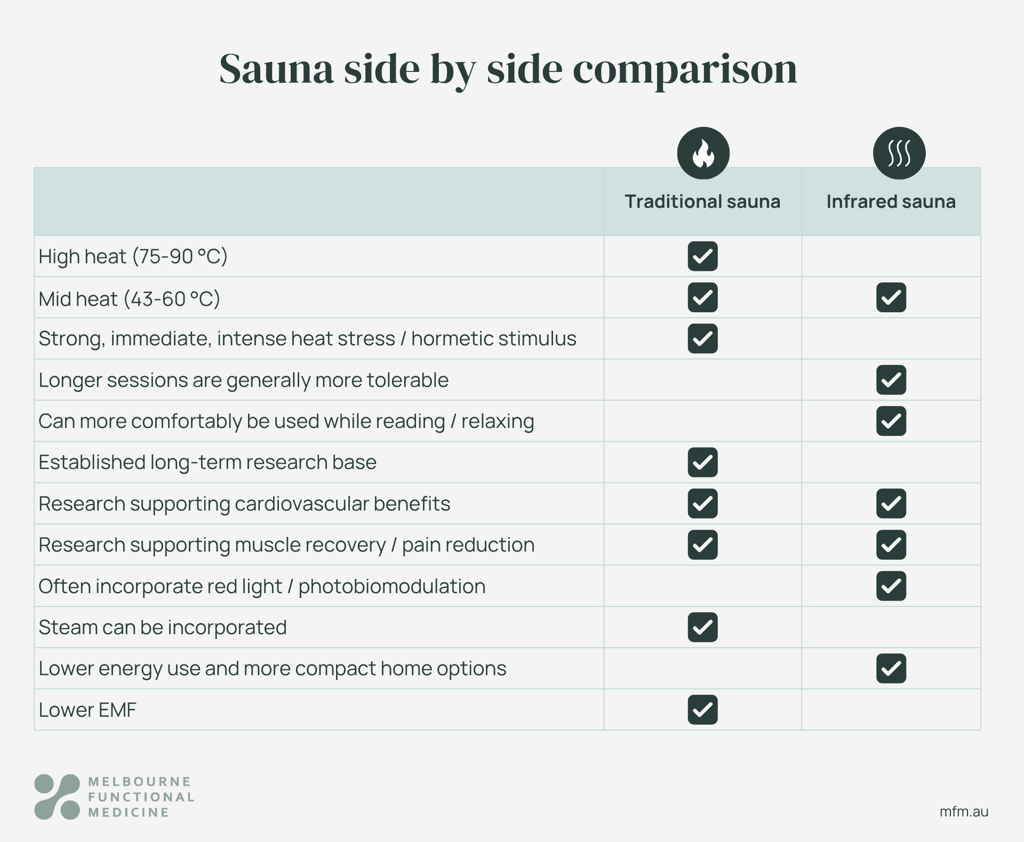
Temperature: roughly 75 to 90°C
Frequency: build up to 3-5 times a week
That mimics the conditions observed in most of the Finnish research linking frequent sauna use to lower cardiovascular and all-cause mortality. And remember, like exercise, consistency beats a single big session.
Contraindications
People with any of the following health considerations should discuss the high heat of traditional sauna use with their own healthcare provider: pregnancy, cardiovascular conditions, diabetes, skin conditions, certain medications, alcohol and drug use and chronic dehydration.
Key considerations for a purchase of a traditional sauna
Remember the following when considering investing in a traditional sauna:
- It needs proper ventilation and usually a dedicated space, cabin or a bathroom that can handle heat and moisture
- Higher power demands to heat the sauna compared to infrared, especially if it’s a large cabin
- Often you need hardwired 3-phase power, not just a plug-in
- Traditional saunas (timber, proper heater) are typically a bigger upfront investment than infrared
- Ensure you buy from a reputable brand, using high-quality materials and solid timber (engineered wood, cheap glues and artificial sealants can release
- Volatile Organic Compounds (VOCs) or formaldehyde when heated.)
- More intense heat can be a lot for beginners or anyone heat-sensitive, however, more immediate and intense heat means more intense hormetic response (that’s a good thing)
Infrared saunas
What is an infrared sauna?
In short, it is a sauna that heats its space differently. Instead of one heater in a corner, heating the air to make it really hot (traditional), an infrared sauna uses many heat panels all throughout the cabin to warm your body directly. Because you sit close to the panels, they transfer their heat to your body more readily, thus heating you from within rather than heating the air in the room around you so much.
You will still find the air temperature in an infrared sauna heats up nicely, say to 60°C, but that is lower than the 75 to 90°C of a traditional sauna. So yes, traditional saunas are hotter, but because you are sitting much closer to the source of heat, and nicely absorbing that radiating heat, your body temperature still rises, you still break a sweat, and your body still mimics being in a cardiovascular exercise state.
Because the air temperature is substantially lower, people often describe infrared as a “gentler” heat, even though your body is doing similar work in response to that heat.
The carbon heat panels commonly used in infrared saunas usually emit only far (FIR – Far Infrared) wavelengths. Ceramic panels may edge into mid-infrared.
Not all infrared saunas are the same type of ‘infrared’
The battleground between traditional and infrared is nuanced because the term ‘infrared’ gets complex. Stay with me here as you’ll want to understand these key points:
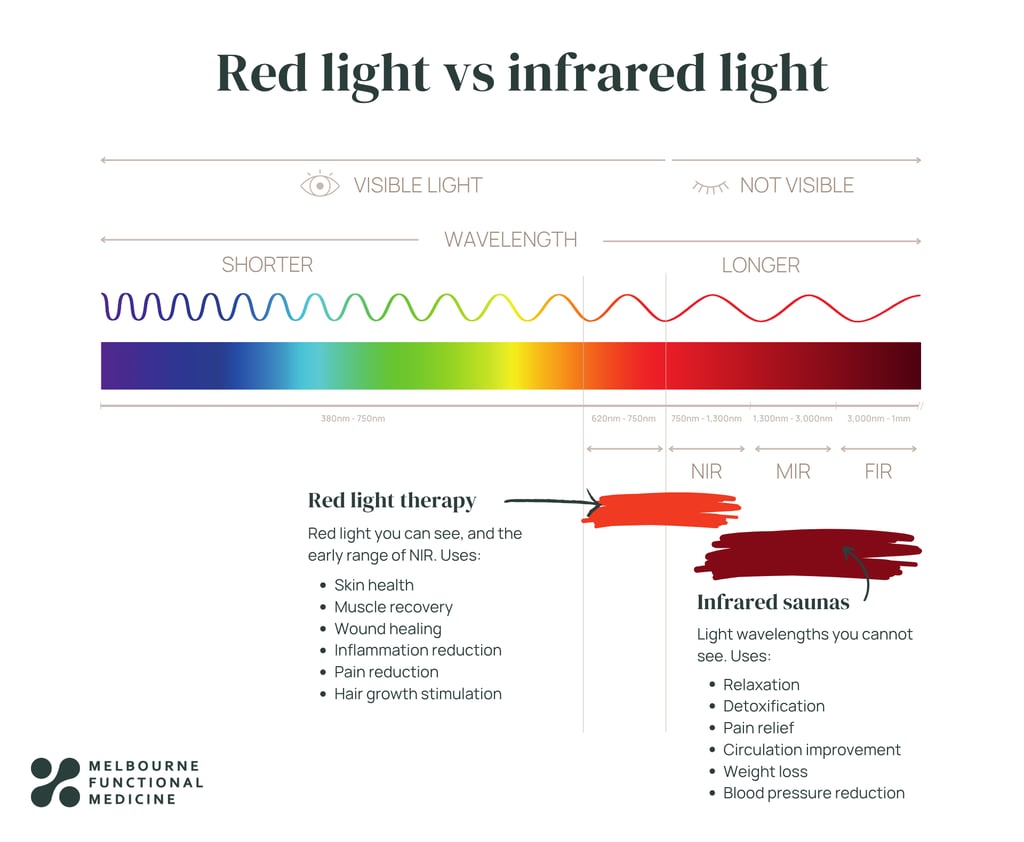
- Infrared light comes in varying wavelengths as measured in nanometers (nm)
- Look at the graphic below, as you’ll see that as the spectrum of light moves into red, as the wavelengths keep getting longer, you stop seeing the colour (not visible) and those wavelengths become felt as heat, not seen as colour
- When that red light moves to being unseeable, it transitions into a band of wavelengths called near-infrared before progressing to mid-infrared and far-infrared
So, not all infrared saunas are the same. Many only use far infrared light. Those with near-infrared light, such as Sunlighten or Sunstream saunas, penetrate into the body in a different way, adding additional benefits that we cover below. These advanced models often also integrate red light therapy, providing the combined benefits of both technologies.
Fun etiological fact: The word infrared comes from the Latin prefix infra (meaning “below” or “beneath”) combined with the English word red. When the two are combined (below+red) it becomes “infrared”. Because infrared radiates just below the visible spectrum of light’s red end, the term designates its place “below red”.
History
Whilst infrared waves were discovered in the late 1800’s, infrared saunas are a much newer invention. Infrared heating technology as a medical tool was being developed from the mid-20th century, but infrared saunas as a wellness product really took off from the 1980s and 90s onward. They were particularly prominent first in Japan and then the US, as manufacturers worked out how to package infrared panels into a home-friendly cabin. So where traditional sauna use has thousands of years of cultural history behind it, infrared has decades.
Let’s talk about light therapy
Well, this opens an entirely new tangent, but it is a major difference and benefit when compared to a traditional sauna. Light therapy is also called photobiomodulation and has strong and growing scientific evidence for positive health outcomes. You can read our summary in our article: Biohacking with light: The science and benefits of photobiomodulation. But in short, humans need light exposure to thrive and with our lives increasingly being lived under a roof or under artificial light, we are oftentimes missing the full spectrum of light waves, and this is where using an infrared sauna can really come into its own. There is immense benefit as a human to be exposed to the full spectrum of light, especially red light, which is increasingly disappearing from our everyday life as we work and live increasingly under LED lights operating in a narrow blue band.
Research and health benefits
Infrared sauna research is not as prolific as the traditional sauna evidence base, but it does have decent direct evidence around:
- pain, particularly chronic pain conditions
- post-exercise muscle recovery
- improving outcomes for patients with chronic heart failure (Waon therapy). Far-infrared sauna therapy, studied under the name Waon therapy, has been trialled repeatedly in Japan with heart failure patients: daily sessions over 2-4 weeks showing improved cardiac function markers (ejection fraction, B-type natriuretic peptide (BNP) levels), better exercise tolerance, and improved quality of life. It’s been adopted as a complementary therapy in some Japanese hospitals alongside standard treatment.
- Improvements in blood pressure and protection against oxidative stress (good for reducing heart disease risk)
Health benefits of red light and near infrared
Red light therapy uses specific wavelengths of visible red light (620 – 750 nm) to target skin and superficial tissues. It uses LEDs to deliver light directly to the skin’s surface, stimulating cellular activity through photobiomodulation. Red light therapy is popular for improving skin health, such as acne, sun-induced ageing and wrinkles, enhancing muscle recovery, especially from injuries, and reducing pain, with sessions typically lasting from a few minutes to half an hour. Some infrared saunas integrate red light LED panels for these benefits.
Near-infrared is a wavelength band where light scatters through tissue rather than being immediately absorbed by water, which lets it travel considerably deeper before losing energy. This is how near-infrared gets absorbed by a specific mitochondrial chromophore called cytochrome c oxidase. That’s a light-driven biochemical reaction, not a heat reaction – the photon energy itself drives increased ATP production, this is the mechanism behind photobiomodulation (PBM).
It’s really important to let you know that the research into near-infrared is almost entirely conducted with dedicated LED or laser devices at specific, controlled wavelengths, not with infrared sauna heating panels.
How to use an infrared sauna
To maximise your benefits we are looking for longer sessions than traditional use:
Session time: around 20 to 45 minutes.
Temperature: roughly 43°C to 60°C
Frequency: build up to 3-5 times a week
A great strategy to habit stack is to do 30 minutes of cardio before your sauna to get your body temperature up, and your lymphatic system activated.
Contraindications for infrared saunas remain per above but can generally be better tolerated because of the lower heat options. Like any heat exposure, hydrate well before and after, and give yourself a proper cool-down between rounds if you’re doing more than one. Listen to your body, if you feel dizzy or unwell, get out.
Key considerations for a purchase of an infrared sauna
Remember the following when considering investing in an infrared sauna:
- Lower temperature makes it easier to sit in for longer, so better for anyone sensitive to intense heat
- Lower temperature means you could habit stack – read a book, write, etc which is harder to do in a traditional sauna
- Lower temperature means you are likely to be in it for much longer
- It also means you are not getting as intense hormetic stress, so some of the benefits from traditional saunas may not fully carry over
- More power-efficient to run than a traditional sauna
- Smaller size options exist compared to traditional, including compact and collapsible tent-like units
- Panels and heating elements have a limited lifespan and may need replacing over time
- There is more electromagnetic energy being projected so be sure to consider low EMF options
- If you want potential Near Infrared benefits, you’ll need to check the spec sheet – remember not all saunas have Near Infrared or even Mid Infrared, all will have Far Infrared. If you want it all, you need to look for “full spectrum” offerings.
Traditional v infrared – which should you choose? Take our sauna quiz!
In information overload? Answer the questions below to see which suits you best. Tally up your letters at the end.
1. How much space do you have?
A) A proper dedicated spot: backyard, garage, or spare room
B) Not much – it needs to be compact, or even foldable
2. How do you feel in intense heat?
A) Bring it on, I love an intense sweat
B) I like warmth, but I don’t want to feel overwhelmed
3. How long do you want a session to take?
A) Quick and efficient, 15 to 20 minutes and done
B) Happy to settle in for 30 to 45 minutes
4. What’s the main benefit you think you are after?
A) Longevity
B) Muscle recovery, joint pain, or general soreness
5. What does your budget and power setup look like?
A) Ready to invest, including any electrical work needed
B) I want something simpler and more energy-friendly to run
6. What’s the vibe you’re drawn to?
A) The full ritual: wood, steam, the Finnish experience
B) Modern tech, sleek panels, dry
7. Would you want to read, work, or scroll while you sweat?
A) No, I want to just sit and be present with the heat
B) Yes, that would actually be ideal
Mostly As? You’re a traditional sauna person. Maximal heat stress, minimal frills, and you’re leaning on the deepest, longest-studied evidence base out there.
Mostly Bs? You’re an infrared sauna person. You want comfort, flexibility, and a gentler heat you can sit with for longer, whilst reaping those infrared heat (and light) benefits.
Need more time to decide? Have a hot bath.
If you are seeking the benefits of heat, this 2025 study from the University of Oregon suggests that a single, 45 min session of hot water immersion places the body under greater physiological stress than either a traditional or far infrared sauna.
You heard right: A bath in hot water produces a larger rise in core body temperature, leading to a stronger cardiovascular response and temporary changes in immune function. This study stunningly showed that a “single bout of hot water immersion elicits the greatest thermoregulatory, cardiovascular, and immune responses compared with both sauna modalities.” Let’s be clear because this study is quite groundbreaking: Hot water immersion produced a markedly greater cardiac output increase and was the only modality to trigger a detectable immune response (IL-6 rise, increased natural killer cells and CD8+ T cells 24- 48 hours later).
But of course, I get it, there is something that feels a bit more indulgent about wandering into your own wooden hot box and the ability to have enough room for friends, unlike the humble bathtub.
Traditional or Infrared, which one does our clinic recommend?
As a clinic, we’re split.
Jabe has a compact collapsible infrared sauna at home. He loves it because it’s small enough to be super convenient and easy enough to use that it gets used, which is half the battle with any health habit. He particularly values the red light therapy benefit he has in his set-up.
As for me, I’m a traditional sauna person, through and through. Maximal heat stress is my love language. I love the ritual of it, the heat, the whole löyly experience. A traditional sauna for my own backyard is very much on my wish list.
The moral of the story: don’t buy based on what’s trending, buy based on what fits your space, your budget, your heat tolerance, and what you’ll likely use three or four times a week.