
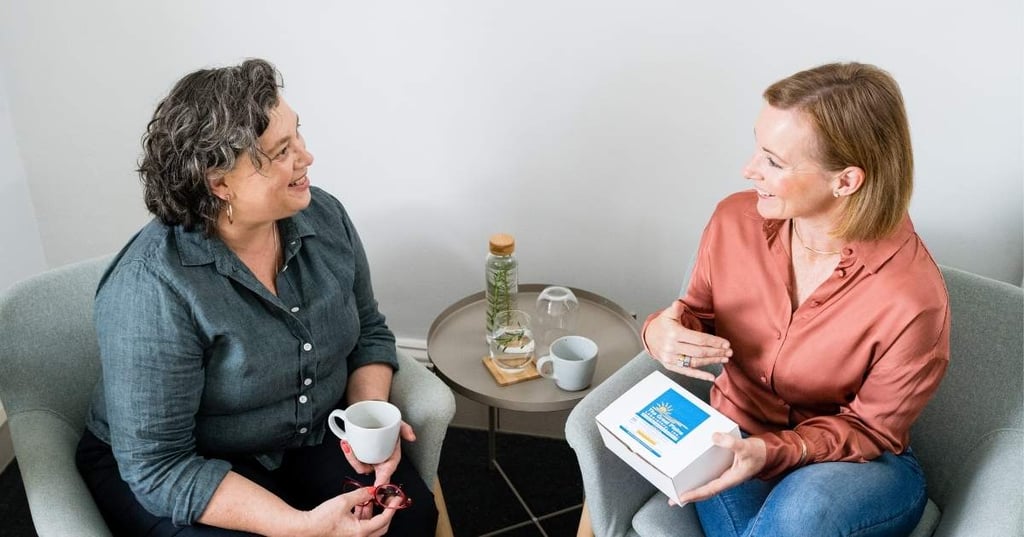

If I had to choose one word to describe what it’s like to be a health coach at Melbourne Functional Medicine, it would be adaptive. A close second would be responsive. And if I could pick a third, it would be curious.
Our days are scheduled, yes, but the experience inside a work day is never the same twice. Coaching calls are diverse and you never know what is about to arise, emotions unfold, and every conversation has its own internal weather system. It’s not just different every day – it is different every call.
Over the last decade, we have fine-tuned how coaching and practitioner work merge together in our ultimate upgrade – our Healthcare Program. In this model, we operate as a team of three – the practitioner, the coach, and you – and the collaboration between us is very on purpose. If you have ever wondered what a coach actually does, or what happens behind the scenes to support your progress, consider this a peek behind the curtain.
The flow of the day
A day as a coach at MFM begins with orientation – a moment to look at the schedule and reorient towards each patient we are meeting. Where are they in their process? What has unfolded since we last spoke? What might they need today?
Then we move to communication – the heartbeat of the healthcare program. As coaches, we are in a constant ebb and flow of sharing, receiving and triaging information. If you’re in our healthcare program, you might update us on symptoms, ask about a supplement, share a concern, celebrate a win, or simply check in. For us, this offers meaningful continuity and connection. It helps us see the moving parts of your journey, not just what appears in a weekly or fortnightly call.
And connection matters. We see again and again that the people who stay connected, who let us into their lived experience, and who are really honest, tend to have the most momentum and progress.
Being a coach also means being comfortable moving between our internal systems – our clinical software (where practitioner notes and treatment plans live), our health dashboard (where your resources and tracking tools are kept), and our communications platforms. Each holds a different part of your story. It might sound administrative, but this is the infrastructure that helps us stay responsive, organised and connected to your care.
Between calls, we are responding to questions, preparing resources, reviewing practitioner updates, sending information to clinic support, or thinking through next steps on your behalf. If we are not listening, we are typing. If we are not typing, we are preparing.
From the coach’s seat
How we coach depends entirely on where you are within your care journey. The phases below follow the experience of a patient who has chosen to work with us in our healthcare program offering.
Early days – the practical phase
When you choose to move into the program, the work is logistical. We help orient you to you to your online notes, walk you through testing instructions, and make sure samples reach the lab without delay. There is momentum here – getting everything underway so treatment can unfold smoothly.
Once the dust settles – the behavioural phase
Then, the focus shifts to intention. Your goals become our anchor. Each patient arrives with their own history, habits, capacity and sense of what “better” means. The practitioner’s plan is thorough and detailed, and our role is to translate it into something that fits the reality of your life.
We are always asking:
- What is doable for you, right now?
- What supports success rather than pressure?
- What can wait, and what is needed today?
The conversations we have
While every call is simply called a coaching session, the nature of those sessions shifts. Common themes include:
- Barriers and roadblocks – time, energy, overwhelm, old habits
- Emotional processing – frustration, fear, sadness, relief
- Mindset shifts – exploring the stories behind behaviours
- Planning and prioritisation – breaking things into achievable steps
- Accountability – gentle momentum, not pressure
- Capacity check-ins – adjusting the pace as life evolves
We work within scope. We are not counsellors, but we can help you untangle a mental knot, name a fear, reconnect to your intention or find steadiness when things feel hard. We do not carry your feelings for you – we walk beside you.
Behind the scenes – what you do not see
Every coaching session is supported by careful, thoughtful preparation. Before we meet with you, we have:
- reviewed practitioner notes
- looked back on our last session
- checked your testing progress
We also do a significant amount of behind-the-scenes work, including:
- tailoring strategies to your capacity and goals
- tracking your progress across sessions
- collaborating with practitioners on updates and refinements
- sharing relevant behavioural insights that may affect treatment
- advocating for you when something clinically meaningful surfaces
- ensuring no information falls through the cracks
We arrive prepared – but also empty. With no agenda. Coaching only works when we begin with your priorities. In fact before picking up the phone, I take a deep belly breath, with a long exhale and arrive at the call ‘reset’. I do this so that I don’t arrive with an agenda and accidentally miss the most important thing you’re experiencing.
How we collaborate with practitioners
One of the strengths of the MFM model is the partnership between coaches and practitioners.
Practitioners
They think in systems, biology, chemistry and timelines. They are solving the scientific puzzle – connecting symptoms to root causes and designing the treatment plan.
Coaches
We think in behaviour, capacity, motivation, emotion, habits, and lived experience – supporting the changes required to make that plan work in real life.
Both perspectives are essential.
Every week, coaches and practitioners meet to debrief cases, share updates and refine the plan. We do not want you repeating yourself or feeling like you start from scratch with each person. Instead, we build a shared understanding, weaving clinical insight with behavioural insight so your care feels seamless.
When practitioners understand what is happening emotionally and behaviourally, their recommendations become more precise and realistic.
When coaches understand biological priorities, the behavioural strategy becomes sharper and more effective.
It is a partnership that honours the complexity of healing.
Real-world examples – from stuck to progressing
These turning points often happen quietly:
- Someone overwhelmed by sleep struggles begins resting earlier after we gently reshape their evening routine
- A patient who keeps forgetting supplements becomes consistent after we co-create a simple, personalised routine that fits their day
- Someone who spirals when stressed learns one grounding technique that stops the overwhelm in its tracks
- A person who has been “starting over Monday” for months, realises they have strung together three steady weeks of progress, without perfection but with momentum
These moments rarely come with fanfare. They arrive mid-sentence, mid-realisation, and they can change everything.
How you fit into the puzzle
You are the most important part of this work.
The practitioner brings clinical expertise.
The coach brings behaviour change expertise.
But you bring honesty, curiosity, capacity, resistance, hope, habit, emotion and commitment. You also bring action.
We do not expect perfection. We expect presence.
Some days you will arrive motivated. Other days you will feel overwhelmed. Everything is welcome. Life does not pause because you are healing. Family dynamics, work stress, fear and old patterns travel with you. Coaching helps you navigate them rather than push them aside.
Overwhelm is common – not because you are incapable, but because healing can be a lot. We help you find your pace, prioritise what actually matters, and stop assuming everything must be done at once.
Habits with deep roots take time to shift. We explore what sits beneath them, interrupt autopilot, and build new rhythms that suit the life you are living.
Boundaries matter too – not just with yourself, but with others. We help you recognise where energy leaks, where you overextend, and where saying no supports healing.
And we teach. Functional medicine is nuanced, and knowledge gaps are normal. We simplify, explain and clarify so you feel confident in the plan rather than overwhelmed by it.
What health coaching looks like in practice
A health coach:
- Helps you translate a complex treatment plan into real-world action
- Supports the emotional, behavioural and mindset shifts needed for change
- Collaborates closely with practitioners so your plan stays cohesive
- Tracks progress and adapts strategies to your capacity
- Helps you build habits that last far beyond the treatment timeline
At the heart of it, coaching is simply about walking beside you while you change your life from the inside out. It is care, it is connection, and it is the quiet kind of transformation that lasts. We are here because we believe in what is possible for you, and we are honoured to support you as you step into that possibility one grounded moment at a time.
Get started today
Our expert health coaches are ready now to work with new and existing patients of Melbourne Functional Medicine. Get started today.