
What is high cholesterol?
High cholesterol (hycholesterolaemia) occurs when there is too much cholesterol circulating in the blood, allowing it to build up in artery walls and raising the risk of heart disease and stroke. Cholesterol itself is a fatty substance the body produces and uses every day: building cell membranes, making hormones, synthesising vitamin D, and supporting brain function. It cannot travel through the bloodstream on its own. It has to travel inside lipoproteins. The type and behaviour of those lipoprotein particles has more influence on cardiovascular risk than total cholesterol number alone.
For many people, diet and physical activity are the primary contributors to elevated levels. For others, the picture is more complex: poor blood sugar regulation, low thyroid function, chronic stress, or a genetic predisposition affecting how the liver processes cholesterol can all push numbers up.
Symptoms of high cholesterol
High cholesterol produces no noticeable symptoms in the vast majority of people. It is often discovered incidentally during a routine blood test. This absence of warning signs is what makes regular screening important, particularly for those over 40, with a family history of cardiovascular disease or hypercholesterolaemia, living with obesity, or with known risk factors such as smoking, low activity levels, or a diet high in saturated fat. For many people, the first indication that cholesterol has been elevated for years is a cardiovascular event.
In cases of severe or longstanding elevation, particularly familial hypercholesterolaemia, physical signs may be present:
- Xanthomas: yellowish cholesterol deposits under the skin, often around the elbows, knees, or tendons
- Xanthelasma: flat, yellowish deposits on or around the eyelids
- Corneal arcus: a pale grey or white ring around the outer edge of the cornea, more significant when it appears before age 45
These signs can indicate very high circulating lipoprotein levels. If you notice any of them, see your GP to have your lipid profile checked.
What causes high cholesterol?
High cholesterol most commonly develops when the liver produces or retains more LDL cholesterol than the body can clear, often as a result of diet, reduced physical activity, and metabolic changes that affect how fats are processed. The risk is less about cholesterol as a substance and more about the lipoprotein particles that carry it, particularly LDL, VLDL, and ApoB, which correlate most strongly with cardiovascular disease development.
Diet is the most frequently cited contributor. A high intake of saturated and trans fats increases LDL production in the liver, while a low intake of soluble fibre reduces the body’s ability to excrete bile acids, which are made from cholesterol.
Excess refined carbohydrates and sugar raise triglycerides and lower HDL independently of fat intake. High alcohol intake raises triglycerides and can contribute to liver fat accumulation, further affecting lipid clearance.
Several other contributors are important and often overlooked:
- Insulin resistance: when cells become less responsive to insulin, the liver increases fat production and VLDL output, raising triglycerides and indirectly lowering HDL
- Hypothyroidism: thyroid hormones regulate LDL receptor activity on liver cells; when thyroid function is low, the liver clears LDL more slowly, and levels rise
- Gut microbiota: gut bacteria influence lipid metabolism through two pathways. They regulate bile acid reabsorption, which affects how much cholesterol the liver recycles. Certain bacterial strains produce trimethylamine N-oxide (TMAO), a compound associated with increased cardiovascular risk independent of LDL levels
- Chronic kidney or liver disease: both can impair the body’s ability to process and clear lipoproteins from the bloodstream
- Chronic stress: elevated cortisol stimulates cholesterol synthesis and can contribute to insulin resistance
- Sedentary lifestyle: low levels of physical activity reduce HDL and slow the body’s clearance of triglyceride-rich particles
- Excess weight: particularly central adiposity, is associated with higher triglycerides, lower HDL, and more atherogenic LDL particle types
- Smoking: reduces HDL and accelerates oxidative damage to LDL particles, making them more likely to contribute to plaque formation
Familial hypercholesterolaemia is a genetic condition affecting approximately 1 in 250 Australians, involving a mutation in the LDL receptor gene that reduces the liver’s ability to remove LDL from the blood. People with familial hypercholesterolaemia can have very high LDL from childhood regardless of diet, and the condition significantly increases early cardiovascular risk. A family history of cardiovascular disease in a first-degree male relative before age 55, or a female relative before age 65, is a key clinical indicator. Some population groups, including Indigenous Australians and those of African heritage, also carry a hereditary predisposition to dyslipidaemia and elevated cardiovascular risk.
Complications of high cholesterol
The primary complication of persistently elevated artery-damaging lipoproteins is atherosclerosis, where lipoproteins deposit in the inner walls of arteries and contribute to plaque formation. This narrows the arteries, reduces their flexibility, and creates sites where blood clots can form or where plaque can rupture.
Depending on which arteries are affected, the consequences can include:
- Coronary artery disease, which may present as chest pain or lead to heart attack
- Stroke or transient ischaemic attack if plaque or clots affect the carotid or cerebral arteries
- Peripheral arterial disease, causing reduced blood flow to the legs and other peripheral tissues
The risk of these outcomes depends not only on LDL levels but on the presence of other cardiovascular risk factors, including high blood pressure, high blood sugar, smoking status, and the degree of existing vascular inflammation. High cholesterol is one component of a broader cardiometabolic picture.
How is high cholesterol investigated and assessed?
A standard lipid panel measures total cholesterol, LDL, HDL, and triglycerides. Australian guidelines define high cholesterol as total cholesterol above 5.5mmol/L for the general population, or above 4.0mmol/L for those at high cardiovascular risk. A standard lipid panel is a useful starting point, but total cholesterol alone is not a reliable indicator of cardiovascular disease risk. What matters more is the composition of the lipid profile – the type, quantity, and behaviour of the lipoprotein particles carrying cholesterol through the bloodstream.
LDL (also referred to as LDL-C [LDL-Cholesterol]) is not inherently harmful; the concern arises when it is present in excess and particles begin depositing in artery walls. LDL particle size matters: small, dense LDL particles are more likely to deposit in artery walls than large, buoyant ones, yet they may not be captured by a standard LDL-C reading.
Apolipoprotein B (ApoB) provides a clearer measure of how many artery-damaging particles are in the blood, because each LDL, VLDL, and IDL particle carries exactly one ApoB molecule. So the ApoB count reflects the number of these particles rather than how much cholesterol they’re carrying. Non-HDL cholesterol, which captures all artery-damaging particles in a single figure, is a useful complement to LDL-C. A 2025 systematic review of more than 590,000 participants found ApoB to be a stronger predictor of cardiovascular risk than LDL-C alone.
In addition to a standard lipid panel, comprehensive functional testing may assess:
- ApoB, LDL particle size, and LDL sub-fractions to assess artery-damaging particle burden and identify small, dense LDL patterns not visible on a standard panel
- Fasting glucose and fasting insulin to evaluate metabolic function and insulin sensitivity
- Thyroid function, including TSH and free T4, to rule out hypothyroidism as a contributing cause
- High-sensitivity CRP (hs-CRP) to check inflammation levels in the blood vessels
- Omega-3 index to measure the levels of healthy essential fatty acids
- Lipoprotein(a) (Lp(a)), an inherited particle that raises cardiovascular risk on its own and isn’t picked up by a standard panel
- Blood clotting factors, which affect how likely a clot is to form where plaque has already built up
- Liver function, given the liver’s central role in cholesterol metabolism
- Personal and family history of cardiovascular disease
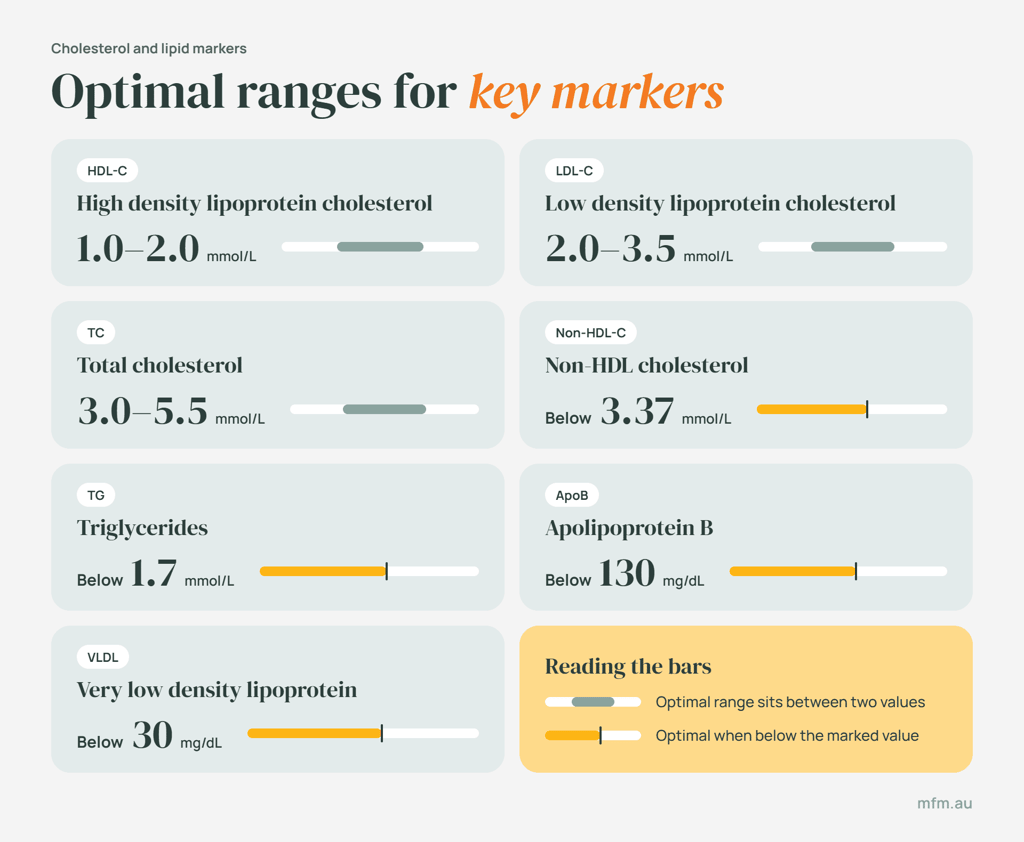
Optimal ranges for key cholesterol and lipid markers are shown below:
Why high cholesterol can remain elevated after treatment
High cholesterol often persists because the conditions contributing to overproduction or impaired clearance in the liver remain unaddressed. Statins and dietary changes can reduce circulating LDL effectively, but neither intervention addresses why the liver is producing or retaining more cholesterol than the body can clear.
Commonly used statins work by blocking the HMG-CoA reductase enzyme the liver uses to make cholesterol. This reduces circulating LDL while the medication is active. When statins are stopped, the enzyme becomes active again and cholesterol returns to pre-treatment levels within weeks. Muscle pain and aches are among the most commonly reported side effects of statins, and are a frequent reason people seek alternatives or stop treatment altogether.
When statins are not tolerated or prove insufficient, other medications such as fibrates, ezetimibe, and nicotinic acid may be prescribed.
For some people, cholesterol remains elevated despite medication because an underlying condition such as hypothyroidism, liver dysfunction, or impaired kidney function has not been identified or addressed.
Diet alone can have a limited effect for the same reason. Roughly 75 percent of circulating cholesterol is produced by the liver; the remainder comes from what you eat. A person with insulin resistance, low thyroid function, or chronic systemic inflammation may eat an excellent diet and still have persistently elevated LDL because the liver’s metabolic environment has not changed.
This is particularly relevant for people with familial hypercholesterolaemia, where the LDL receptor itself is impaired. No amount of dietary modification will restore receptor function. For people with this condition, a combination of medical management and targeted metabolic support tends to produce better outcomes than either approach alone.
Treating high cholesterol: a functional medicine approach
A functional medicine approach to high cholesterol treats an elevated lipid profile as a signal that points toward insulin resistance, thyroid function, inflammation, or genetic predisposition, rather than a number to be suppressed. The starting point is understanding which of these is at play.
Depending on your presentation, care may include:
- Dietary approaches: Increasing soluble fibre, plant sterols, and reducing refined carbohydrates, sugar, and trans fats can work together to lower how much cholesterol your body absorbs and produces, and are typically the first line of care
- Blood sugar and insulin regulation: Where insulin resistance is present, reducing refined carbohydrates and added sugars and improving meal timing may lower your triglycerides, raise HDL, and help move LDL toward a larger, less harmful particle type
- Thyroid function: Where subclinical hypothyroidism is identified, supporting thyroid function through nutrition, stress reduction, or targeted supplementation may help your liver clear LDL more efficiently
- Reducing inflammation: An anti-inflammatory diet rich in omega-3s from oily fish, olive oil, and colourful vegetables, alongside nutrients like fish oil and curcumin, may lower vascular inflammation that raises your cardiovascular risk independently of cholesterol numbers
- Lifestyle factors: Regular aerobic exercise, addressing poor sleep, and managing stress can help regulate the cortisol and insulin dynamics that influence your cholesterol
- Targeted supplementation: Nutrients such as berberine, red yeast rice, coenzyme Q10, and plant sterols may support your cholesterol metabolism and lipid particle profile
We support people with high cholesterol to look beyond the number on your results
We work with people at every stage, from a first borderline result to years on statins.
When to seek support
See your GP or a practitioner if you have:
- No lipid panel in the past two years, particularly if over 40
- A family history of cardiovascular disease or high cholesterol
- Borderline results that haven’t been followed up
- A close family member diagnosed with familial hypercholesterolaemia
- A cardiac event or known cardiovascular disease
- Cholesterol medication without a full cardiometabolic assessment
- Risk factors such as obesity, insulin resistance, type 2 diabetes, or a sedentary lifestyle, with lipids never checked
Frequently asked questions
Can you lower cholesterol without statins?
Yes, many people can lower cholesterol without statins, particularly when levels are mildly elevated and a contributing cause such as insulin resistance or low thyroid function is found and addressed. Where cardiovascular risk is already high or familial hypercholesterolaemia is present, statins are often appropriate, and a functional medicine approach works alongside them rather than replacing them.
Do eggs raise cholesterol?
No, for most people the cholesterol in eggs has only a small effect on blood cholesterol, because the liver makes less of its own when you eat more. Some people respond more strongly. People with type 2 diabetes, heart disease or high LDL are generally advised to keep to seven eggs or fewer per week.
How quickly can diet and lifestyle changes lower cholesterol?
Cholesterol often starts to come down within six to 12 weeks of consistent diet and lifestyle changes, which is why levels are usually rechecked at around three months. Triglycerides tend to respond faster than LDL. Where insulin resistance or low thyroid function is involved, levels tend to improve as that underlying cause is addressed.
Does menopause raise cholesterol?
Yes, cholesterol often rises during menopause, with LDL and ApoB climbing most steeply in the year either side of the final period. HDL usually stays flat, so a lipid panel can look more reassuring than it is. Menopausal hormone therapy can lower LDL and Lp(a), but it isn’t used as a cholesterol treatment or a substitute for a statin.
What is lipoprotein(a) and why does it matter?
Lipoprotein(a), or Lp(a), is an inherited particle that raises cardiovascular risk independently of LDL. It isn’t measured on a standard lipid panel, and diet and statins do little to lower it. Because levels stay largely stable through adulthood, one test is usually enough, and a high result means other risk factors are managed more closely.
Should I be concerned if my LDL is normal but my ApoB is high?
Yes, a high ApoB is a concern even when LDL is normal, because cardiovascular risk follows the number of particles more closely than the cholesterol they carry. This pattern usually reflects many small, dense LDL particles and is common with insulin resistance and high triglycerides. Improving blood sugar control can help lower ApoB in this situation.
Why do some people have high triglycerides but normal LDL?
High triglycerides with normal LDL often reflect high carbohydrate and sugar intake, excess alcohol, insulin resistance, or low thyroid function. In this pattern, VLDL particles are elevated rather than LDL, and HDL tends to be low. This combination carries cardiovascular risk that a normal LDL result can hide, which is why non-HDL cholesterol or ApoB gives a more accurate picture.
Can stress raise cholesterol?
Yes, stress can raise cholesterol, particularly when it continues for weeks or months. Ongoing high cortisol prompts the liver to make more cholesterol and makes cells less responsive to insulin. Long periods of stress also tend to cut into sleep, exercise and regular eating, which each affect lipid levels in their own right.
Ready to find out why your cholesterol is high?
If you’re looking for a clearer picture of what’s raising your levels, learn more about our approach to high cholesterol testing and care.