

What is hyperthyroidism?
Hyperthyroidism is a condition in which the thyroid gland produces more thyroid hormone than the body needs. Thyroid hormone controls how fast your metabolism runs. When there’s too much of it, everything speeds up at once: your heart, your digestion, your temperature, even your mood. That’s why symptoms can show up in so many different parts of the body.
The most common cause is Graves’ disease, an autoimmune condition in which the immune system produces antibodies that bind to and continuously stimulate thyroid tissue, keeping it producing hormone regardless of what the body needs.
Graves’ disease is far more common in women than men and most often appears between the ages of 20 and 50, though it can occur at any age. People with existing autoimmune conditions (including rheumatoid arthritis, coeliac disease, lupus, Addison’s disease, vitiligo, pernicious anaemia and type 1 diabetes) carry a higher risk, as does a family history of Graves’ disease or smoking.
Symptoms of hyperthyroidism
The most common symptoms of hyperthyroidism are cardiovascular and metabolic, including a rapid heart rate, weight loss, tremor, and anxiety, often appearing together and sometimes mistaken for stress.
Symptoms may not be obvious until the condition is well established. Older adults may instead have fatigue, low mood and withdrawal, rather than the more typical anxiety and restlessness. This is known as apathetic hyperthyroidism, and it can delay diagnosis for some time.
Cardiovascular and nervous system
- Rapid heart rate or palpitations
- Trembling hands
- Nervousness and anxiety
- Difficulty sleeping
- Irritability
Metabolic and physical
- Weight loss or difficulty gaining weight even when eating enough
- Increased sweating
- Heat intolerance
- Muscle weakness
- Frequent bowel movements
Skin, hair and nails
- Hair loss
- Soft or brittle nails
- Warm, moist palms
- Thickened skin on the shins or feet (Graves’ disease specifically)
Hormonal and reproductive
- Light or irregular menstrual periodsInfertility
- Miscarriage and pregnancy complications
Eyes (Graves’ disease)
- Bulging or protruding eyes, double vision, light sensitivity or eye pain, known as Graves’ eye disease
Thyroid gland
- Swelling at the front of the neck that you can see or feel, caused by an enlarged gland (goitre)
What causes hyperthyroidism?
While hyperthyroidism is most commonly caused by autoimmunity known as Graves’ disease, other causes include thyroid nodules, thyroiditis and, in rare cases, a pituitary tumour, or excess iodine intake. The cause is important because it affects how long the condition is likely to last and which treatments will be most appropriate.
Graves’ disease
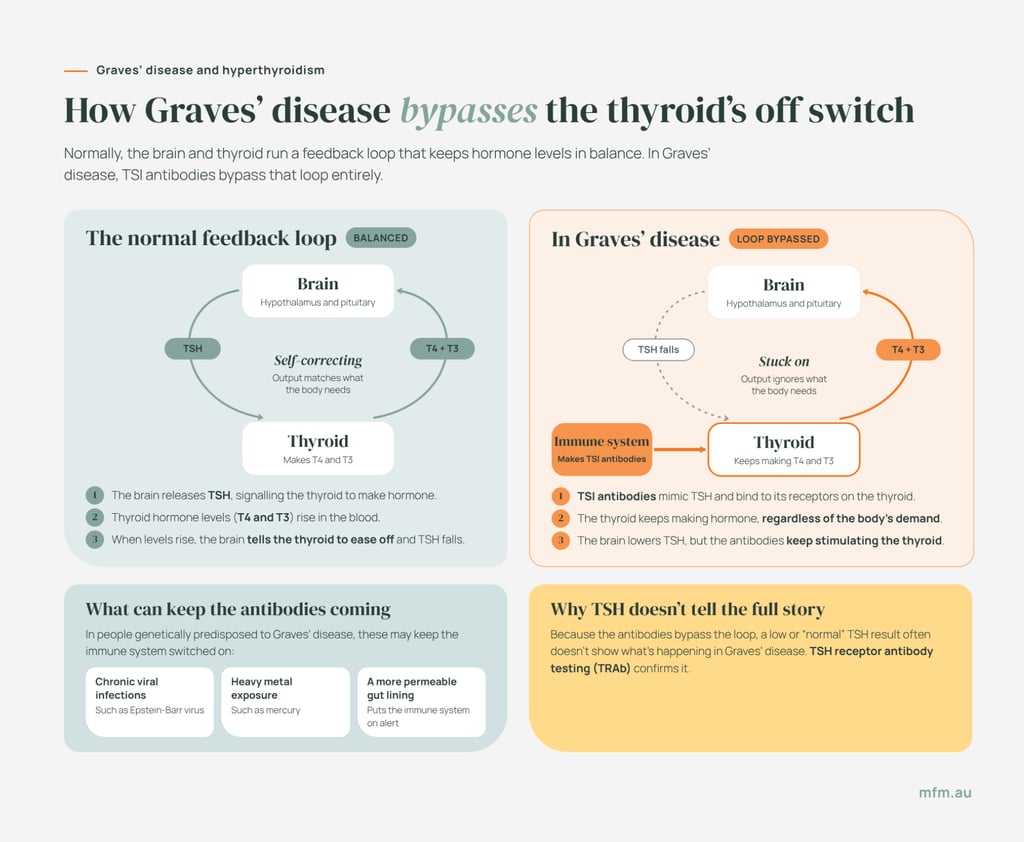
In Graves’ disease, the immune system produces thyroid-stimulating immunoglobulins (TSI), antibodies that mimic thyroid-stimulating hormone (TSH) and bind to TSH receptors on the thyroid gland. Normally, the brain and thyroid run a feedback loop (called the hypothalamic-pituitary-thyroid axis): when hormone levels rise, the brain tells the thyroid to ease off.
TSI antibodies bypass that loop entirely. They keep stimulating the thyroid no matter how high hormone levels get, which is why TSH on its own can’t show what is causing the problem, and antibody testing is needed to confirm Graves’ disease.
Other causes
- Thyroid nodules: benign growths within the gland that start making hormone on their own, regardless of what the body actually needs. More common in older adults
- Thyroiditis: inflammation causes stored hormone to leak into the bloodstream. This form tends to be self-limiting and may be followed by a period of low thyroid output
- Subacute thyroiditis: painful thyroid inflammation, often triggered by a viral or bacterial infection
- Silent thyroiditis: painless thyroid inflammation, often autoimmune in origin
- Postpartum thyroiditis: hormonal changes following pregnancy can trigger inflammation and transient hyperthyroidism. This condition often follows a three-stage pattern: an overactive phase first, then an underactive phase, and in most cases a return to normal, though some women go on to develop permanent hypothyroidism
- Pituitary tumour: in rare cases, a benign tumour causes excess TSH production, which drives the thyroid to overproduce
- Excess iodine: the thyroid uses iodine to make T3 and T4. High intake from iodised salt, seaweed, or supplements can trigger excess hormone production in some people
- Thyroid medication overcorrection: doses prescribed for hypothyroidism can occasionally push levels into the hyperthyroid range
- Medication-induced: certain medications can trigger hyperthyroidism independently of iodine intake. Amiodarone, a cardiac drug with very high iodine content, is one of the more common drug-related causes and can induce hyperthyroidism even in people with previously normal thyroid function
Contributing factors in Graves’ disease specifically
In people with a genetic predisposition to Graves’ disease, a few things can push the immune system toward producing TSI antibodies:
- Chronic viral infections: Epstein-Barr virus and related infections have been associated with immune system changes that affect the thyroid
- Heavy metal exposure: mercury from amalgam fillings, contaminated water, or dietary sources has been shown to impair thyroid and immune function
- Increased intestinal permeability: when the gut lining becomes more permeable, proteins, microbial fragments, and partially digested food particles can enter the bloodstream. This puts the immune system on constant alert, and in someone already predisposed to Graves’ disease, that ongoing alert state may help drive the production of TSI antibodies
These all result in the immune system going a bit off the rails. In an unsuccessful attempt to try and deal with whatever is going on, the immune system tries to adapt and increasingly responds in all sorts of ways, some of which cause an undesired and ineffective response, such as with Graves’ disease. Ultimately, we want to aim to calm the immune system by identifying what is annoying it so much and causing it to go so wrong.
How is hyperthyroidism investigated and assessed?
Hyperthyroidism is diagnosed with blood tests that show low TSH alongside high thyroid hormone levels, guided by your symptom history and a physical examination. Your GP will also look for signs of Graves’ disease, such as an enlarged thyroid (goitre), eye changes or thickened skin on the shins.
Standard blood testing
- TSH (thyroid-stimulating hormone) is usually very low or undetectable, because the pituitary gland stops signalling the thyroid when hormone levels are high
- free T4 and free T3, the main thyroid hormones, show whether levels are raised
- TSH receptor antibodies (TRAb), which include the TSI antibodies that stimulate the thyroid, confirm Graves’ disease when positive
In subclinical hyperthyroidism, TSH is low but free T4 and T3 stay within the normal range. Symptoms may still be present. Reference ranges are based on population averages, so a functional medicine practitioner also looks at where your results sit within the range, how they have changed between tests and how they match your symptoms.
Imaging
- a radioactive iodine uptake scan shows how much iodine your thyroid is taking up, which helps tell Graves’ disease apart from thyroiditis
- a thyroid ultrasound checks the size and structure of the gland and looks for nodules
Functional testing
Functional testing looks at what may be keeping your immune system active, and is chosen based on your history. It may include:
- Repeat antibody testing: your GP or endocrinologist may recheck TRAb before you stop antithyroid medication. Tracking TRAb and TSI levels more regularly, across several tests, shows whether the autoimmune activity is easing with treatment, alongside whether your hormone levels are under control
- A full thyroid array: including TSH, T3, T4, TPOAb, TGAb, TRAb, so we have a complete picture of what is going on, inclusive of other antibodies that may be present
- Nutrient levels: selenium, zinc, vitamin D and ferritin (iron stores), which often run low in hyperthyroidism and are needed for healthy thyroid and immune function
- Genetic testing, including methylation testing: helps establish any genetic immune system tendencies, how well your body regulates itself, methylation ability, detoxification issues, and a lot that can be relevant for Graves. Comprehensive stool testing: looks at your gut bacteria, inflammation in the gut and whether the gut lining has become more permeable, or there might be an infection or significant microbiome imbalance.
- Heavy metal testing: urine or hair testing to check for a build-up of mercury or other toxic metals
- Epstein-Barr virus (EBV) antibody panel: a standard EBV test only shows whether you’ve had the virus at some point. A more detailed panel including IgM antibodies can help show whether it has become active again and may be contributing to ongoing immune activity
- Cortisol rhythm testing: measures your main stress hormone at several points across the day. Long-term stress can change this pattern and make immune activity harder to calm, and standard testing does not pick it up
Diagnosing hyperthyroidism requires a clinical history, physical examination, and targeted blood testing. The presence of a goitre, eye changes, or skin findings consistent with Graves’ disease, alongside a relevant symptom history, guides initial testing.
Why symptoms can return after treatment
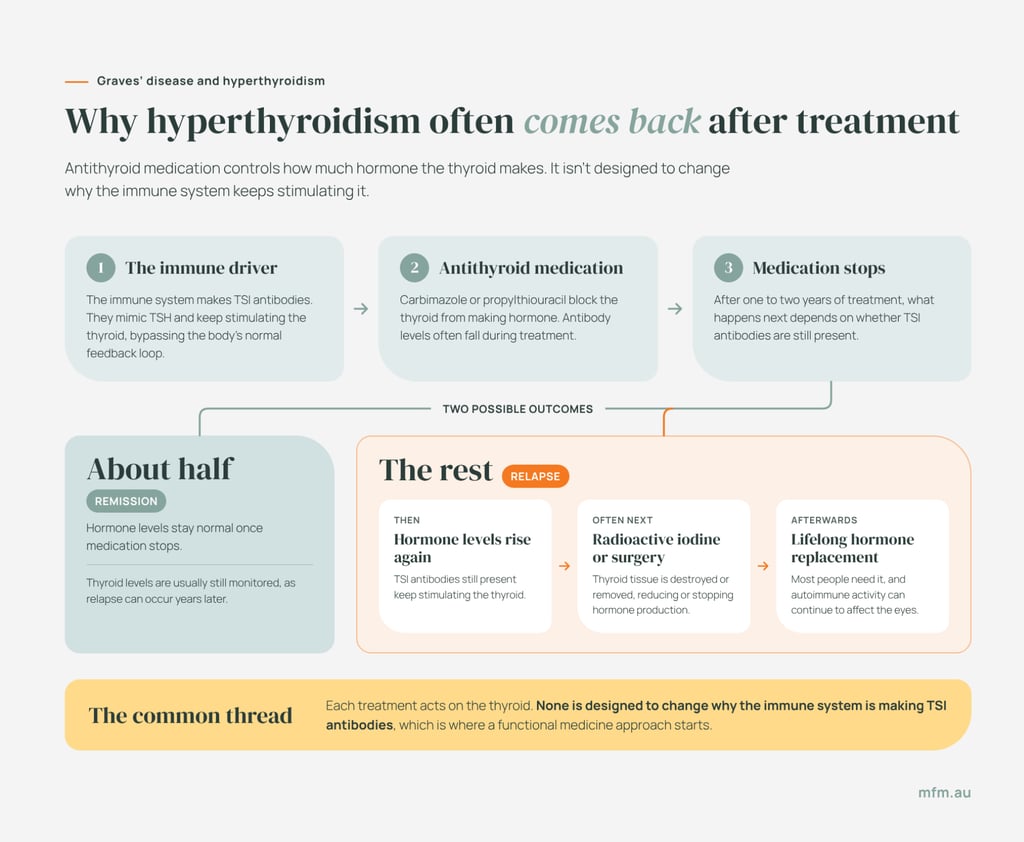
Hyperthyroidism caused by Graves’ disease often comes back after treatment because antithyroid medications control how much hormone the thyroid makes without changing why the immune system is stimulating it.
Antithyroid medications such as carbimazole and propylthiouracil block the thyroid from making hormone. After one to two years of treatment, around half of people go into remission, meaning their hormone levels stay normal once the medication stops.
For the rest, hormone levels rise again once medication stops. Antibody levels often fall during treatment, but the medication isn’t designed to change why the immune system is making TSI antibodies. If these antibodies are still present when medication stops, they keep stimulating the thyroid.
Radioactive iodine and surgery are often recommended if remission isn’t reached or hyperthyroidism comes back. Radioactive iodine destroys some or all of the thyroid tissue, and surgery removes the gland. Both reduce or stop hormone production, but neither changes why the immune system was overstimulating the gland in the first place.
After either procedure, most people need lifelong thyroid hormone replacement, and the autoimmune activity can continue to affect other parts of the body, including the eyes.
Treating hyperthyroidism: a functional medicine approach
A functional medicine approach to hyperthyroidism starts by identifying what’s keeping your immune system switched on, since in Graves’ disease, that’s what’s behind thyroid overactivity, not the thyroid itself. That means reviewing your symptom history alongside standard and functional test results to build a clearer picture of what’s changed in your immune and gut function, and why. Treatment is then built around what’s keeping your immune system active, not just the symptoms it’s producing.
Depending on your presentation, treatment may include:
- Dietary change: gluten-containing grains, legumes, caffeine, alcohol, and high-iodine foods such as seaweed are commonly removed or reduced, as each can trigger inflammation, worsen symptoms, or feed thyroid overproduction. Importantly, what diet works for others won’t be the same for you; it is a good deal of work to figure out what best suits your body, but well worth it!
- Nutritional support: selenium, zinc, vitamin C, L-carnitine, CoQ10, and vitamin D are commonly depleted in hyperthyroidism and may be recommended to support thyroid conversion, immune regulation, and the physical effects of excess thyroid hormone
- Gut restoration: where the gut lining has become more permeable, probiotics, gut-lining support such as glutamine or zinc carnosine, and anti-inflammatory herbs may be used to reduce the immune activity driving antibody production
- Immune modulation: omega-3 fatty acids, vitamin D, and glutathione may help calm an overactive immune response, alongside herbs such as bugleweed and lemon balm, which may act directly on thyroid-stimulating receptors to ease symptoms
- Addressing toxic load and infections: where testing identifies a heavy metal burden, toxins such as mycotoxins, or a chronic infection such as Epstein-Barr virus, reducing exposure and supporting detoxification may help calm the immune activity behind your symptoms
- Stress and cortisol support: regular movement, consistent sleep, and breathwork may help regulate cortisol, which can otherwise worsen anxiety, sleep, and heart rate alongside excess thyroid hormone
We support people with hyperthyroidism to optimal health
Reclaiming your health starts with understanding what’s contributing to your symptoms. Start your care journey today.
When to seek support
See your healthcare provider if you have:
- Palpitations, tremor, or a persistently rapid heart rate
- Unexplained weight loss despite eating normally
- Anxiety, irritability, or sleep difficulties without a clear cause
- A visible swelling in the neck, or changes to your eyes
- Symptoms that have returned after reducing or stopping antithyroid medication
- Antibody levels that remain elevated despite treatment
- A personal or family history of autoimmune conditions and would like earlier assessment
- A sudden high fever, rapid heart rate, confusion, or agitation, which can signal thyroid storm and requires immediate emergency treatment
Frequently asked questions
Can hyperthyroidism go away on its own?
Sometimes. Hyperthyroidism can go away on its own when it is caused by thyroiditis, which is temporary inflammation of the gland. Thyroiditis after a viral infection or childbirth usually resolves within several months, though an underactive phase often follows. Graves’ disease rarely resolves without treatment, because the antibodies keep stimulating the gland. Overactive nodules also keep making hormone on their own.
Is Graves’ disease the same as hyperthyroidism?
No, hyperthyroidism describes too much thyroid hormone in the blood, while Graves’ disease is an autoimmune condition and its most common cause. The two can also exist separately. Graves’ eye disease can appear while thyroid levels are normal, and the antibodies can remain after radioactive iodine or surgery.
Can Graves’ disease go into permanent remission?
Yes, Graves’ disease can go into long-term remission, though relapse can occur years later, so thyroid levels are usually monitored after medication stops. Remission is less likely with a large goitre, high antibody levels when medication stops, or ongoing smoking. Lowering antibody levels before stopping, and addressing what keeps the immune system active, may improve the odds.
Can hyperthyroidism cause weight gain?
Hyperthyroidism usually causes weight loss, but some people gain weight because excess thyroid hormone also increases appetite, and eating can outpace the extra energy burned. Weight gain is more common once treatment begins, as metabolism slows before appetite adjusts. If treatment tips levels into the underactive range, weight can climb further, which is a reason to recheck thyroid levels.
What happens if hyperthyroidism is left untreated?
Untreated hyperthyroidism raises the risk of an irregular heart rhythm called atrial fibrillation, which can lead to blood clots, stroke and heart failure. Excess thyroid hormone also speeds up bone loss, increasing fracture risk, particularly after menopause. In rare cases, a sudden surge in hormone causes thyroid storm, a medical emergency that needs immediate hospital care.
Can stress trigger Graves’ disease?
Yes, stress may trigger Graves’ disease in people who are already genetically prone to it, with studies linking major life events to onset. Ongoing stress changes cortisol output, which affects how the immune system is regulated. Some research also links ongoing stress to a higher chance of relapse after medication stops.
Can pregnancy cause hyperthyroidism?
Yes, pregnancy can cause temporary hyperthyroidism because the pregnancy hormone hCG (human chorionic gonadotropin) stimulates the thyroid in the first trimester, especially with severe morning sickness. Gestational hyperthyroidism usually resolves by mid-pregnancy without antithyroid medication. It’s important to tell it apart from Graves’ disease, which needs active management in pregnancy. Postpartum thyroiditis can also appear in the year after birth.
Does hyperthyroidism affect fertility?
Yes, hyperthyroidism can affect fertility by making periods irregular or lighter and ovulation less predictable, and in men it can lower sperm quality. Fertility often improves once hormone levels are stable. If you have Graves’ disease, reaching stable hormone levels and lower antibody levels before conceiving reduces the risk to the baby’s thyroid, as the antibodies can cross the placenta.
Ready to understand what's contributing to your hyperthyroidism?
Learn more about our approach to hyperthyroidism testing and treatment.