

IBS and diarrhoea are often confused. Loose stools, urgency, cramping, and bloating can appear in both conditions, and from the outside, they don’t always feel easy to separate.
Clinically, though, they behave quite differently. IBS typically follows a pattern – periods of stability followed by flare days, often influenced by stress, certain foods, hormonal changes, or shifts in routine.
Diarrhoea, by contrast, can arise for a wide range of reasons: an infection (recent or past), bile acid issues, medication reactions, or simply a gut that is irritated and moving too quickly, such as in hyperthyroidism.
When you’re experiencing the symptoms in real time, those differences aren’t always obvious.
Part of the complexity comes from how conventional healthcare systems approach these issues. When blood tests, imaging, and standard stool assessments are normal, IBS is often used as the default label. While IBS is a valid diagnosis, it doesn’t always explain persistent diarrhoea or the nuances of someone’s symptom pattern.
This is why, in functional medicine, we focus on distinguishing the symptom (diarrhoea) from the condition (IBS). Once that distinction is clear, the underlying causes – and the appropriate next steps – become much easier to identify.
To clarify whether symptoms align more with IBS or another cause of diarrhoea, it helps to define how each behaves clinically and what patterns we look for in practice.
What defines IBS – and how it differs from diarrhoea
IBS is a functional gut condition. The digestive tract looks structurally normal, but the way it moves, communicates, and responds is altered. Diagnosis typically relies on symptoms being present for several months and following a recognisable pattern rather than on abnormalities found in testing.
In practice, one of the hallmark features of IBS is a repeating symptom rhythm – flare periods followed by relatively stable phases – even if the triggers aren’t immediately obvious.
There are several IBS subtypes – IBS-D, IBS-C and IBS-M – and the mixed pattern in particular can make symptoms feel inconsistent. This variability is one of the key clues we use when distinguishing IBS from other conditions that tend to produce more consistent stool patterns.
The table below summarises the key distinctions between IBS and diarrhoea from other causes:
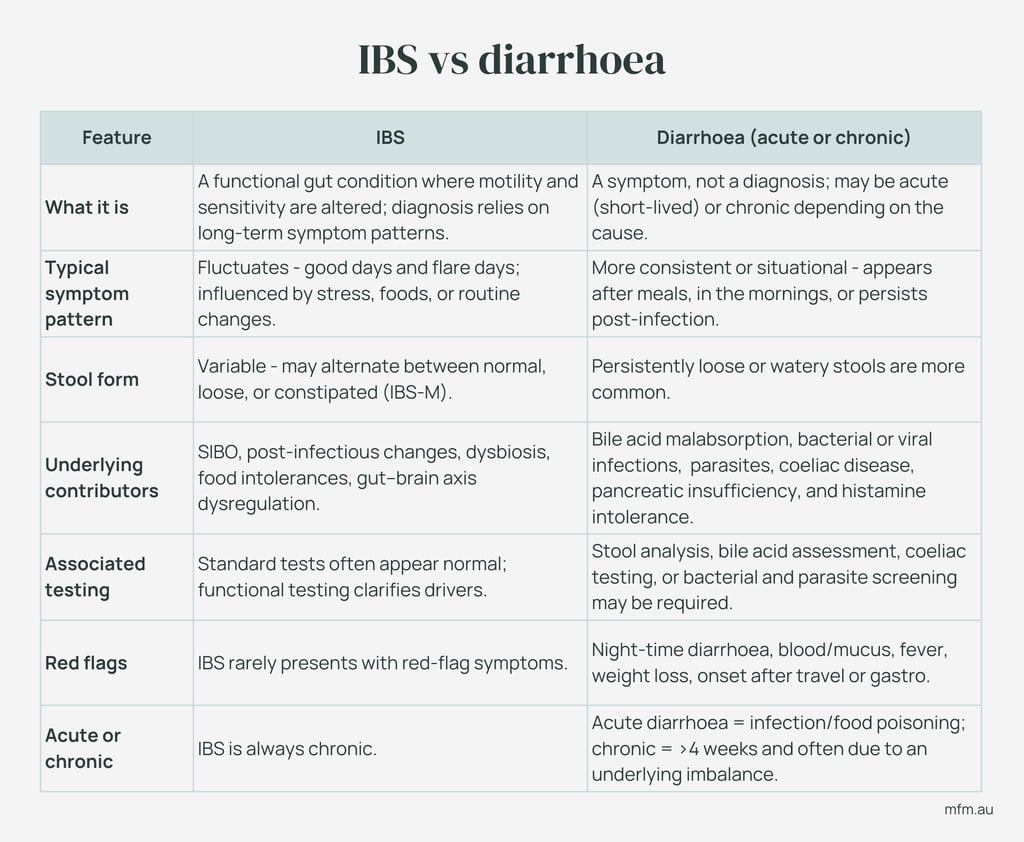
Understanding these distinctions helps narrow down which underlying contributors are most likely and sets the stage for choosing the most meaningful tests.
Clinically, the timing of diarrhoea – whether it appears after meals, first thing in the morning, or unpredictably throughout the day – often gives us one of the strongest clues about the underlying cause.
Functional testing that helps identify the real cause
In functional medicine, testing is personalised and function-focused. The choice of assessment depends on your symptom pattern, how quickly stools move through the digestive tract, and whether symptoms began gradually or suddenly.
For example:
- If symptoms worsen soon after eating, we often prioritise bile acid and enzyme assessments
- If bloating accompanies diarrhoea, SIBO testing is frequently informative
- If symptoms began after an infection, stool analysis is usually the first step
Useful investigations may include:
- SIBO breath testing
- Comprehensive stool analysis (large intestinal microbiome, pathogens (bacterial or viral), parasites, inflammation, digestive markers)
- Bile acid assessment
- Coeliac screening
- Functional blood tests (iron, B12, thyroid function, inflammatory markers)
Testing helps move from broad assumptions to specific explanations – making treatment more targeted and effective.
When to seek a deeper diagnosis
A closer look is worthwhile when:
- Diarrhoea lasts longer than four weeks
- Symptoms began after gastro or food poisoning
- Symptoms began after travelling overseas
- Typical IBS strategies haven’t provided meaningful relief
- Meals trigger uncertainty or avoidance
- Symptoms feel inconsistent with your usual pattern
Clearer diagnosis allows for more targeted intervention and reduces the need for ongoing guesswork.
How a functional medicine approach brings clarity
A functional medicine approach helps us understand what’s driving your symptoms so we can match treatment to what your gut actually needs.
A functional approach looks at:
- Long-term symptom patterns, not isolated flare days
- Potential contributors such as SIBO, bile acids, the microbiome, or post-infectious changes
- Targeted treatments that match the underlying driver
- Rebuilding digestive tolerance rather than restricting the diet
- Supporting gut–brain communication to reduce reactivity
In many cases, even small shifts, once aligned with the right underlying cause, make the digestive system feel far steadier.
If your symptoms haven’t fitted neatly into one category, that’s not uncommon. IBS and diarrhoea can look similar day to day, yet arise from different mechanisms.
Once the pattern and underlying contributors are identified, treatment becomes more precise and the gut typically becomes more stable.
Understanding the “why” behind your symptoms is an important part of restoring confidence in how your digestion responds.