
What is psoriasis?
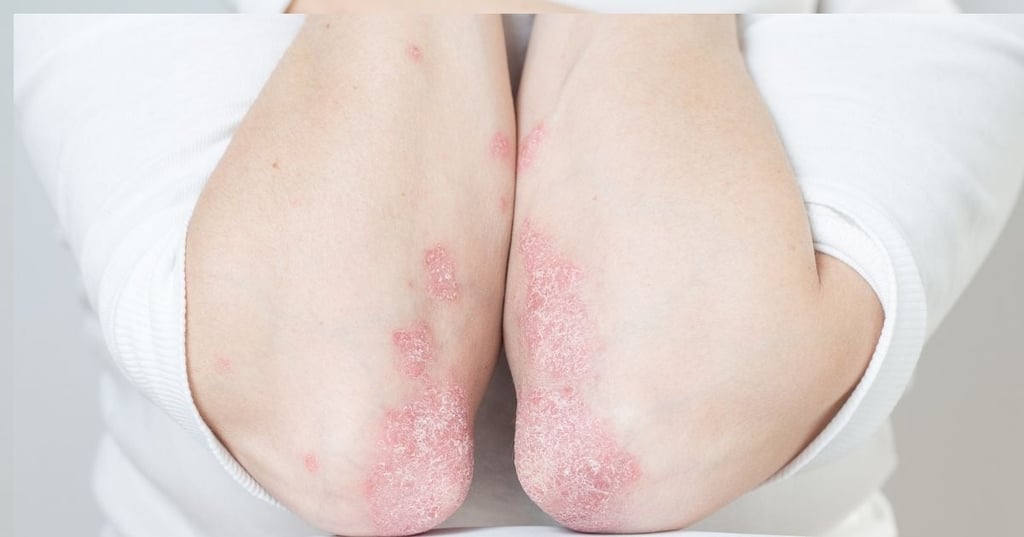
Psoriasis is often thought of as a skin disease, but it is actually an autoimmune condition, occurring when the immune system becomes overactive and signals skin cells to multiply far faster than they should. Normally, skin cells are produced and shed over about a month. In psoriasis, that cycle can speed up to just a few days, causing cells to build up on the surface and form the raised, thickened, scaly plaques the condition is known for.
It is estimated that 1.6 million Australians are living with psoriasis, and it looks and feels differently from person to person. For some, it is a mild and occasional nuisance. For others, it is widespread, persistent, and affects daily life, confidence, and sleep.
The changes to the skin are the most visible sign of psoriasis, but the condition extends beyond the skin. Some people also develop psoriatic arthritis, which causes painful, inflamed joints. Research has also established links between psoriasis and inflammatory bowel diseases, while emerging evidence is exploring how the gut microbiome, intestinal barrier and immune system may interact with the inflammatory processes involved in psoriasis.
Symptoms of psoriasis
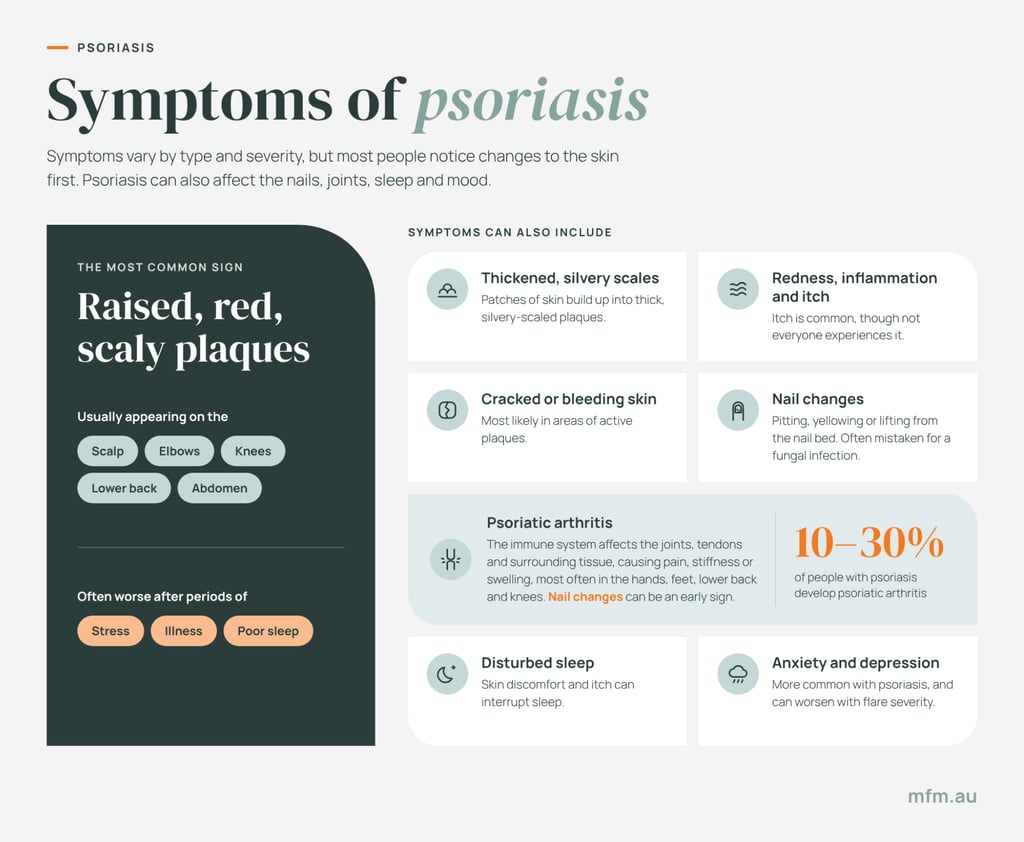
The most common sign of psoriasis is raised, red, scaly plaques, appearing on the scalp, elbows, knees, lower back, and abdomen, and typically worsening after periods of stress, illness, or poor sleep.
Symptoms vary by type and severity, but commonly include:
- thickened, silvery-scaled patches on the skin
- redness, inflammation, and itching, though not everyone experiences itch
- cracked or bleeding skin in areas of active plaques
- nail changes including pitting, yellowing, or lifting from the nail bed, sometimes an early sign of psoriatic arthritis, and often mistaken for a fungal infection
- psoriatic arthritis, a condition in which the immune system affects the joints, tendons, and tissue around them, developing in around 10-30% of people with psoriasis; joint pain, stiffness, or swelling most commonly affects the hands, feet, lower back, and knees
- disturbed sleep due to skin discomfort or itch
- anxiety or depression, which are more common in people with psoriasis and can worsen with flare severity
Symptoms tend to come and go, with flares followed by calmer periods. Flares are often triggered by infection, emotional stress, alcohol, certain medications, or skin trauma. Some people find their skin worsens in winter with reduced sun exposure.
Types of psoriasis
The five main types each have a distinct presentation:
- Plaque psoriasis: the most common form, affecting up to 80% of people with psoriasis. Red, scaly plaques appear most often on the scalp, face, elbows, knees, abdomen, and lower back. On lighter skin, plaques typically appear red with silvery scaling; on darker skin, they may appear grey, violet, or dark brown, often with thicker scaling and less visible redness. Post-inflammatory pigmentation changes can persist after plaques resolve and are sometimes mistaken for ongoing disease activity
- Inverse psoriasis: smooth, inflamed red skin without scaling, typically in skin folds such as the underarms or groin. Affects around one in four people with psoriasis
- Guttate psoriasis: small, round, red spots on the trunk, often appearing after a streptococcal throat infection
- Pustular psoriasis: white pustules surrounded by inflamed red skin
- Erythrodermic psoriasis: a rare but serious form causing intense redness, pain, and large-scale shedding of skin across much of the body
What causes psoriasis?
Psoriasis most commonly develops in people who carry genes that make their immune system prone to overreacting. Gut health, infection, stress, and environmental exposures then influence whether and how severely that overreactivity shows up.
The immune response at the core of psoriasis involves immune cells called T-cells becoming activated and triggering a chain reaction of inflammation that accelerates skin cell production. The cells produced are not fully matured, yet they build up faster than they can be shed, forming the plaques visible on the surface.
Several contributing factors appear consistently in people with psoriasis:
- Gut health and the microbiome: Research has identified a distinct pattern of gut dysbiosis, an imbalance in gut bacteria, in people with psoriasis and psoriatic arthritis. This involves intestinal permeability (a gut lining that lets more through than it should), changes in how the gut’s immune system responds, and reduced populations of bacteria that produce short- and medium-chain fatty acids
- Infection: guttate psoriasis in particular frequently follows streptococcal throat infection. In people who are genetically susceptible, an infection can activate the immune system enough to trigger psoriasis
- Stress: stress activates inflammatory signalling in the body and is a well-established trigger for both the onset of psoriasis and subsequent flares
- Skin trauma: physical injury to the skin, including cuts, burns, and abrasions, can trigger new plaques at the site of damage. This is known as the Koebner phenomenon
- Nutritional status: deficiencies in zinc, vitamin D, and essential fatty acids can each influence immune function and the inflammatory response in the skin
Body weight: excess adipose tissue (body fat) produces pro-inflammatory signals that can heighten immune activity, and obesity has a demonstrated relationship with psoriasis severity - Medications: certain drugs including lithium, some blood pressure medications, antimalarials, and NSAIDs can trigger or worsen psoriasis in susceptible people
- Toxin and chemical exposure: fragrances in skincare, cleaning products, and personal care items can be particularly irritating in people with psoriasis, and heavy metals, alcohol, and smoke may also contribute to flares
- Existing autoimmune conditions: around 25% of people with one autoimmune condition go on to develop additional autoimmune conditions, so the presence of another autoimmune diagnosis raises the likelihood of psoriasis
How is psoriasis investigated and assessed?
Psoriasis is typically diagnosed clinically, through examination of the skin by a GP or dermatologist, sometimes with a small skin biopsy to confirm the diagnosis under a microscope. Several conditions can look similar, including eczema and fungal infections, and a confirmed diagnosis is important because treatment differs between them.
Conventional assessment focuses on identifying the type and severity of psoriasis, as well as any joint involvement that may warrant referral to a rheumatologist.
A functional medicine assessment looks beyond the skin to understand what is keeping the immune system overactive. This may include:
- detailed clinical history covering diet, stress, sleep, gut function, and flare patterns
- microbiome analysis to assess the composition and diversity of the gut bacterial community
- inflammatory markers in blood
- assessment of vitamin D, zinc, essential fatty acids, and other nutritional markers. Vitamin D in particular is commonly low in people with psoriasis and is one of the first markers checked
- heavy metal testing where environmental exposure is relevant
- evaluation of other autoimmune conditions or immune-related history
Why psoriasis can continue after treatment
Psoriasis often persists or returns because conventional treatments reduce the inflammatory response and slow skin cell turnover, but do not change what is activating the immune system in the first place.
Topical corticosteroids can suppress local inflammation effectively. Ultraviolet B phototherapy can slow skin cell production and reduce plaque activity, but its effect lasts only as long as treatment continues. Stronger medications taken orally or by injection, including methotrexate, cyclosporin, and acitretin, work more broadly by dampening immune activity across the body. Biologic therapies, which target specific immune messenger proteins including IL-17 and IL-23, are increasingly used for moderate-to-severe psoriasis and can produce marked short-term improvement. When any of these treatments stop, the immune overactivity often resurfaces and plaques return, sometimes more extensively than before.
These medications also carry side effects that limit how long they can be used, ranging from liver and kidney strain to risks during pregnancy. Methotrexate can cause nausea, elevated liver enzymes, and in serious cases bone marrow suppression. Cyclosporin is associated with high blood pressure and kidney impairment. Acitretin carries risks including elevated liver enzymes, raised blood lipids, and significant effects on foetal development. Both acitretin and methotrexate require pregnancy to be avoided during treatment and for a period after stopping. Because of these limitations, treatment often cannot continue long enough to produce lasting change.
Gut health is another area that standard treatment does not typically address. Research has identified consistent associations between psoriasis severity and the state of the gastrointestinal tract. When gut inflammation and microbial imbalance are left unaddressed, they may continue to activate the immune response that appears at the skin surface. Treating the skin without considering what is happening in the gut is a common reason people cycle through improvement and relapse.
Treating psoriasis: a functional medicine approach
A functional medicine approach to psoriasis treats the immune system, behind the skin symptoms. That means understanding what has made the immune system overactive, and addressing that.
A practitioner will take a detailed clinical history before any treatment begins, covering diet, stress, sleep, gut function, and flare patterns. Treatment is then built around what a patient’s personalised health picture shows.
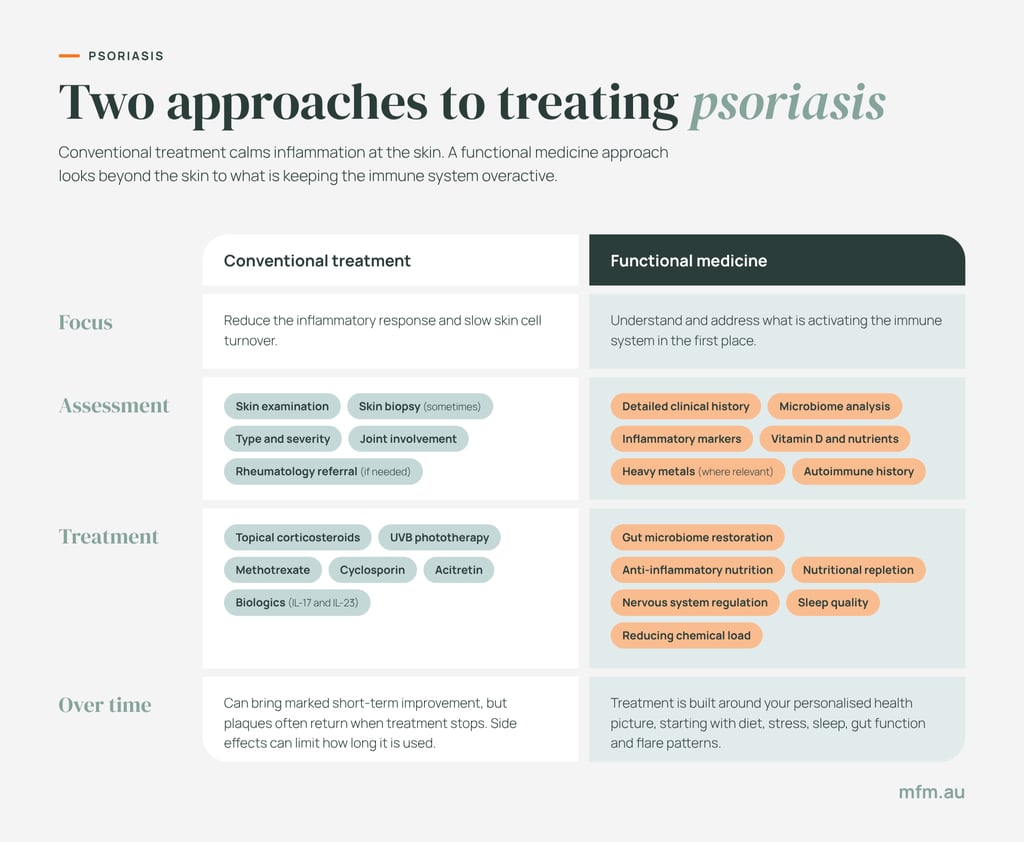
Strategies that may be used include:
- Gut microbiome restoration: Restoring a healthier gut bacterial community is often a focus of care, using dietary changes, targeted probiotic support, and addressing gut lining permeability that may be promoting immune activation
- Anti-inflammatory nutrition: A Mediterranean-style diet rich in olive oil, omega-3 rich fish, nuts, and vegetables may help ease symptom severity, while cutting back on refined carbohydrates, sugar, dairy, and processed foods can ease flare activity
- Nutritional repletion: Vitamin D, zinc, essential fatty acids, and vitamin C are commonly low in people with psoriasis and each influence the skin’s immune and inflammatory response, with digestive support added where nutrient absorption needs help
- Nervous system regulation: Calming your stress response through breathwork, vagal nerve stimulation, and movement can help. Stress-related inflammation can keep skin flaring, so herbs like ashwagandha and rhodiola may be used where more direct support is needed
- Sleep quality: Poor sleep is more common in people with psoriasis and reduces the skin’s capacity for overnight repair. When sleep quality is poor, support such as sleep hygiene, nervous system settling practices before bed, and magnesium can help, since your skin does much of its repair work overnight
- Reducing environmental and chemical load: Cutting back on synthetic fragrances and chemical irritants in skincare, cleaning, and personal care products can help lower your skin’s overall inflammation if you’re sensitive to them
We help people with psoriasis work towards calmer, more manageable skin
work with people at every stage of psoriasis, from a first patch of plaques to years of cycling through steroid creams that only work while you’re using them.
When to seek support
See your GP or a practitioner if you have:
- Skin symptoms affecting your sleep, confidence, or daily life
- Symptoms that keep returning after treatment
- Joint pain or stiffness alongside skin symptoms
- Long-standing psoriasis without a clear understanding of what’s contributing to it
Frequently asked questions
Is psoriasis contagious?
No, psoriasis is not contagious. It cannot be passed from person to person through touch, shared items, or any form of contact. It is an autoimmune condition arising from how the immune system responds internally, not from infection or exposure.
What is the difference between psoriasis and eczema?
Psoriasis and eczema both cause red, inflamed skin but are distinct conditions. Psoriasis produces thickened, scaly plaques on the elbows, knees, scalp, and lower back. Eczema produces itchy, weeping, or dry skin that is less clearly bordered and tends to appear in skin creases. Psoriasis is autoimmune; eczema involves a defective skin barrier and hypersensitivity to environmental triggers.
Is psoriasis hereditary?
Psoriasis has a strong genetic component. Having one parent with the condition roughly doubles the likelihood of developing it, and having two affected parents increases that risk further. Carrying the relevant genes doesn’t guarantee psoriasis will develop, but it does mean the immune system is more likely to overreact when other triggers are present.
Can psoriasis affect the joints?
Yes. Around 10-30% of people with psoriasis develop psoriatic arthritis, a condition in which immune activity affects the joints, tendons, and surrounding tissue. The hands, feet, lower back, and knees are most commonly affected. Morning stiffness, joint swelling, and fatigue are common features. Psoriatic arthritis can cause cumulative joint damage, so it needs early assessment and treatment.
Can psoriasis go away on its own?
Psoriasis can go into remission, sometimes for months or years, but it does not resolve permanently without addressing what is keeping the immune system overactive. Most people experience a cycle of flares and calmer periods. For some, remission is extended and stable. Understanding personal triggers and contributing factors is usually what influences how that pattern unfolds.
Does stress make psoriasis worse?
Stress does not cause psoriasis, but it is one of the more consistent triggers for flares in people who already have the condition. Stress activates the body’s inflammatory response, which can push the immune system toward the kind of overreactivity that produces skin symptoms. Managing the stress response is therefore clinically relevant, not just psychologically supportive.
Can gut health affect psoriasis?
Research consistently shows associations between psoriasis severity and the state of the gut. People with psoriasis show altered gut bacterial communities, increased intestinal permeability, and higher rates of inflammatory bowel disease compared to the general population. Addressing gut health is increasingly understood to be relevant in managing the condition.
Can certain medications trigger psoriasis?
Yes. Lithium, some blood pressure medications including beta-blockers, antimalarial drugs, and NSAIDs are among the medications associated with triggering or worsening psoriasis in susceptible people. If you notice a change in your skin after starting a new medication, raise it with your prescribing practitioner.
We help people with psoriasis work towards calmer, more manageable skin
work with people at every stage of psoriasis, from a first patch of plaques to years of cycling through steroid creams that only work while you’re using them.