
Bowel habits aren’t a topic most people bring up easily, but they’re one of the clearest signals your digestive system gives you when something isn’t quite right.
For many people, the frustrating part isn’t a lack of effort. They’re eating well, staying hydrated, moving regularly and still not seeing the consistency they’d expect. That pattern is worth paying attention to, because it often points to something beyond the basics.
This article covers what a healthy bowel rhythm looks like, what stool patterns can indicate, and why fibre and water alone don’t always address what’s driving the problem.
What your bowel habits can tell you
Let’s start with the basics – what does “healthy” actually look like?
For most people, that means:
- Going once (sometimes twice) a day
- Stool that passes easily – not too hard, not too soft
- A feeling of complete emptying
- No need to strain or “push”
“If you’re sitting there every morning hoping something will happen, or if you only go every few days, that’s a signal worth taking seriously — not a reason to reach for harsher laxatives, but a prompt to look at why motility has slowed.”
– Rebecca Hughes
Understanding stool types
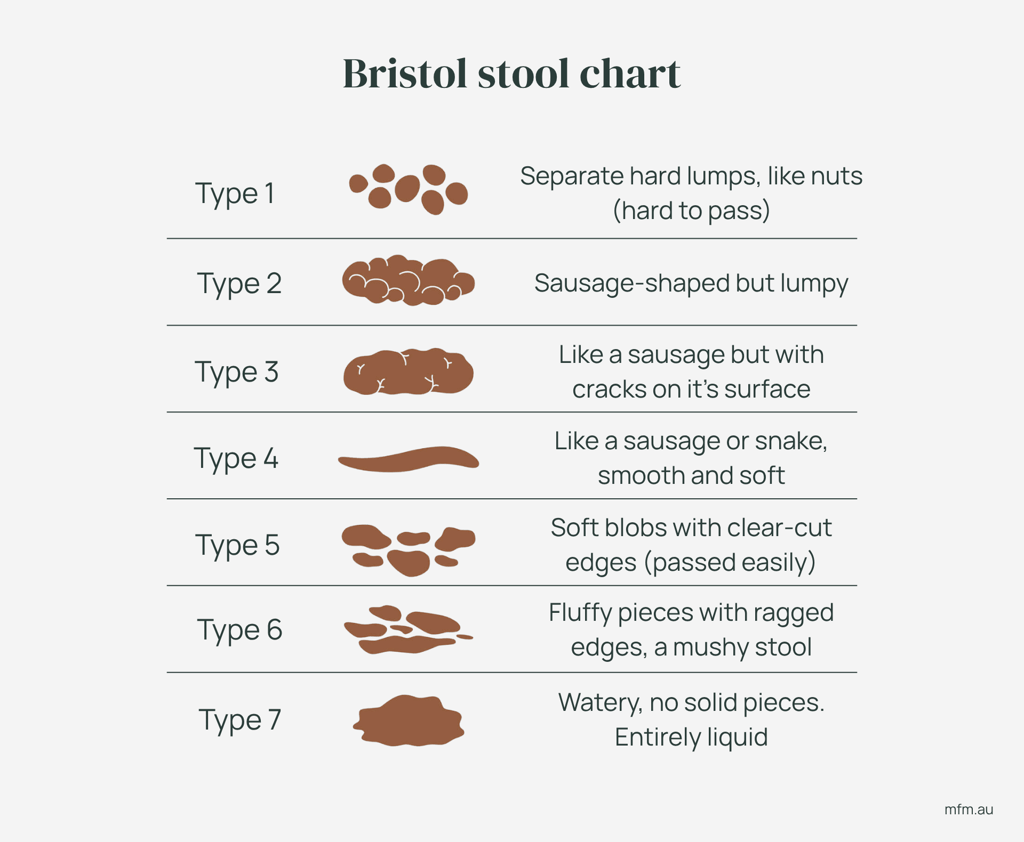
The Bristol Stool Chart is a helpful visual that classifies poo into seven types based on shape and consistency.
If your stool is Type 1 or 2 – small, hard, pellet-like – that’s constipation. Not just “your normal.” It means things are moving slowly.
Type 4 is ideal – smooth, soft, and easy to pass. That’s your gut doing its job efficiently, without strain.
What colour, timing and consistency can indicate
Bowel movements are your body’s quiet way of sharing what’s happening inside. Some things to note:
- Brown: Normal, healthy bile flow
- Pale or clay-coloured: May indicate poor bile production or flow
- Dark or black: Could be from iron supplements or bleeding (check with your doctor)
- Yellow or greasy: Often tied to poor fat digestion
Also, gut motility tends to follow a rhythm. If you’re skipping days or only going on weekends, that might reflect nervous system dysregulation or sluggish motility – not a lack of fibre.
Why it’s not just about fibre and water
You’ve heard the advice: drink more water, eat more fibre. But if that worked for you, you probably wouldn’t be reading this.
The truth is: fibre can help or hinder, depending on the type.
- Soluble fibre (like oats, kiwi, chia) softens stool and supports easier passage
- Insoluble fibre (like bran or raw veg) may worsen bloating in some people, particularly when the gut is already under strain or motility is reduced
And sometimes, it’s not about fibre at all. Constipation may be a sign of:
- Bile flow – reduced bile can slow intestinal motility and contribute to constipation
- Low stomach acid or enzyme production
- Magnesium deficiency
- High stress tightening the gut-brain axis
You may also be eating more protein than your gut can currently handle. A palm-sized piece per meal is usually enough. Larger portions, especially without enough enzymes or bile to break it down, can disrupt the large bowel microbiome and contribute to sluggishness.
Do a quick self-check
Paying attention to patterns over time is often more informative than any single symptom in isolation. A few things worth noting:
- Do you go fewer than three times per week?
- Is there frequent straining or a sense of incomplete emptying?
- Is your stool dry, hard, or sticky?
- Do you regularly feel bloated or “backed up”?
- Is your stool often pale, dark, or greasy-looking?
If two or more sound familiar, it may be time to investigate further.
When testing helps
If constipation has become your “normal” for months or years, it’s worth looking deeper. In clinic, I often recommend:
- Comprehensive stool testing: Assesses inflammation, bacteria, yeast, bile markers, enzyme activity
- SIBO breath test: Looks for small intestinal bacterial overgrowth, which can disrupt motility
- Thyroid and hormone testing: Because metabolism plays a huge role in gut movement
Testing removes the guesswork and helps direct care more precisely.
Where to start with digestive support
Supporting your gut doesn’t have to be complicated. Often, the most helpful changes are the simplest:
- Add electrolytes to your water for better hydration
- Magnesium citrate or glycinate to relax bowel muscles and ease motility
- Bitters or lemon in warm water before meals to support bile flow
- Healthy fats (avocado, olive oil, nuts) to soften and lubricate the bowel
- Gentle walking, yoga or belly breathing to reconnect your nervous system and gut
You can also check out our article: Foods that cause constipation and what to eat instead for more practical swaps.
Constipation is more common, and more complex than most people realise. It’s rarely about one single habit or food, and it’s not something that resolves by simply pushing harder or adding more fibre.
Once you start paying attention to the signals your gut is sending, how often you go, how it feels, and what’s changed over time, patterns begin to emerge. That awareness makes it easier to support digestion in a way that feels sustainable, rather than reactive.
Whether it’s adjusting fibre types, supporting bile flow, calming the nervous system, or looking a little deeper with testing, small, targeted changes can help restore a more natural rhythm. When digestion becomes more consistent, energy, comfort and mood often follow.